

President Orders Urgent Reform of Two Ministries Over Commission Report on April 18 Incident
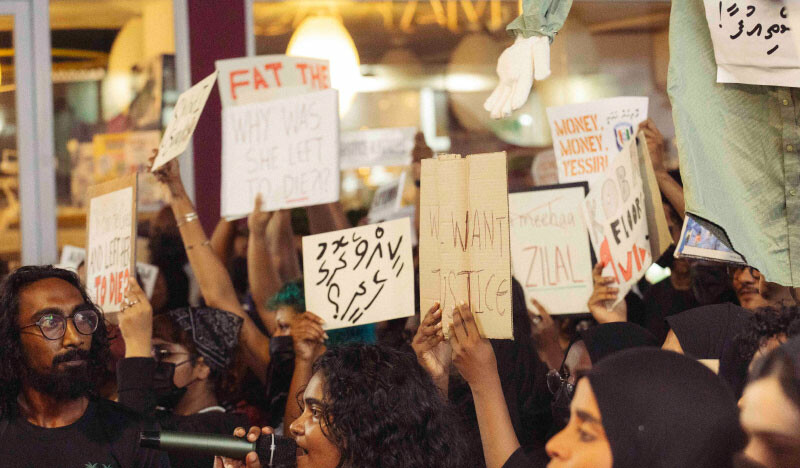
People protesting after the April 18 fall incident, calling for a thorough investigation | Photo: MV+
President Dr Mohamed Muizzu directed immediate action from the Ministry of Homeland Security and Technology and the Ministry of Health to implement key recommendations issued by the Special Presidential Commission investigating the April 18 incident in Malé.
The directive published yesterday follows the Commission’s final report on the events surrounding the fall of a 21-year-old woman from the ninth floor of Fentoniya in Henveiru. She was found around 4:30 a.m. on the roof of a warehouse, H. Mitaz, and remained under treatment at Indira Gandhi Memorial Hospital (IGMH) before being transferred to Malaysia on April 26 for further care.
advertisement

advertisement

Police Failures Under Scrutiny
The President’s directive raises serious concerns about how the Maldives Police Service handled the case, citing systemic failures in basic investigative procedures. Key findings include:
- A one-hour delay in informing the investigation officer, resulting in their arrival after the Scene of Crime Officer had already processed the area.
- The absence of the investigation officer during the crime scene examination led to incomplete evidence collection.
Negligence by the Scene of Crime Officer, who failed to properly process the scene and exited hastily without securing crucial evidence. - No effort to secure or examine the roof of H. Mitaz, where the woman was found — a critical lapse that left potential evidence uncollected.
President Muizzu instructed the Ministry of Homeland Security and Technology to implement immediate reforms. These include revisions to police Standard Operating Procedures (SOPs), mandatory training programs, accountability measures for negligence, and disciplinary action where warranted.
The Commission also highlighted troubling inconsistencies in testimony. In particular, Daudh Ahmed was implicated through witness statements placing him at H. Maira that morning, contradicting earlier accounts given to both the police and the Commission. The report recommended a comprehensive investigation into the events of April 18, noting that Daudh and others at H. Maira failed to report the incident or provide medical assistance to the woman — a failure the Commission described as inexcusable, even from a humanitarian standpoint.
Raudh is the younger brother of Daudh Ahmed Zilal, who had served as the Under Secretary for Digital Strategy at the President’s Office. However, following the incident, he was suspended from his position without pay on April 25, and after the Commission published its report, he was dismissed from his position as he had provided false testimony for this investigation.
Health Sector Lapses at IGMH and FPU
President Muizzu also addressed critical shortcomings at IGMH and its Family Protection Unit (FPU), both under the Ministry of Health’s oversight. According to the Commission’s findings:
- After she was admitted to the ICU, hospital staff requested a sexual abuse assessment, but FPU personnel failed to conduct it — a clear violation of SOPs.
The Commission recommended that hospital doctors be empowered to initiate such examinations if requested by the victim’s family, without having to rely solely on the FPU. - The report called for stronger protocols at the FPU, including mandatory photographic documentation of injuries and immediate collection of forensic evidence where sexual abuse is suspected.
In response, the President has ordered the Ministry of Health to strengthen administrative and clinical protocols at IGMH and the FPU to prevent future oversight and ensure proper care and forensic handling in similar cases.
Commitment to Accountability
President Muizzu emphasised the need for full enforcement of the Commission’s recommendations, stressing that systemic failures — whether in policing or healthcare — must be addressed to ensure justice and prevent recurrence.
The government’s response signals a firm commitment to transparency and institutional reform, as public scrutiny intensifies over the handling of the April 18 case and the broader implications for law enforcement and healthcare in the Maldives.