


President Muizzu Ratifies Public Referendum Bill
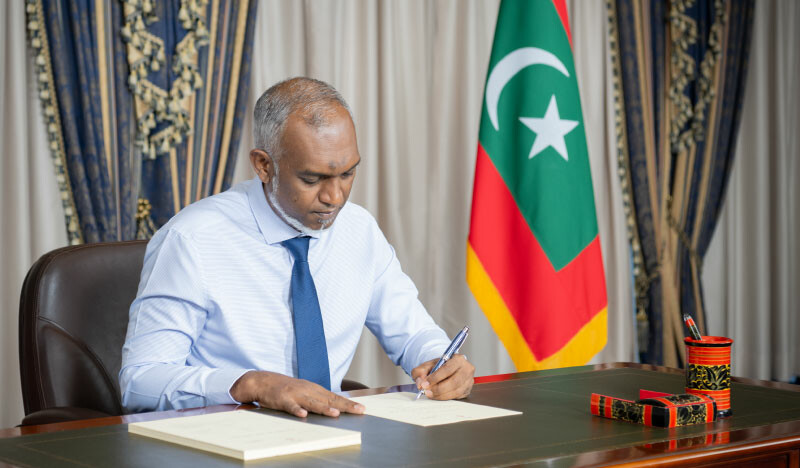
President Dr Mohamed Muizzu ratifying the Public Referendum Act on September 16, 2025 | Photo: President’s Office
President Dr Mohamed Muizzu ratified the Public Referendum Bill yesterday, following its passage at the 5th Special Session of the People’s Majlis on 15 September.
The bill establishes the principles and procedures for conducting referendums on matters of national significance. It allows the People’s Majlis to resolve to hold a referendum, while the President may also call one to determine public opinion on key national issues.
advertisement

advertisement

The legislation makes referendums mandatory before certain constitutional changes can take effect. These include amendments related to:
- important issues that relate to the citizens
- important national matters
- asking the public’s opinion on whether they would like to implement a law that the parliament has passed, which the president refused to ratify
- any amendments to certain articles in the constitution, which include amendments to any of the fundamental rights in chapter two of the constitution, the term of parliamentarians, the presidential term of office and succession of the Vice President, the method of electing the President through universal and secret suffrage, and the territory of the Maldives.
The bill also outlines responsibilities for those proposing a referendum, and sets procedures for the Elections Commission to administer the process.
During Monday’s sitting, 64 members voted in favour while 12 opposed the bill. It was tabled on behalf of the government by Inguraidhoo MP Ibrahim Falah and reviewed by the Committee on Independent Institutions, which held closed-door deliberations before opening its final meeting to the public.
Opposition MPs from the Maldivian Democratic Party (MDP) criticised the legislation, warning it could be open to misuse. South Galolhu MP Meekail Ahmed Nasym alleged the bill contained “a hidden agenda” and raised concerns about the Elections Commission’s authority to draft information material, which he said could allow the government to frame issues in a misleading manner.
South Hithadhoo MP Ibrahim Nazil, the minority leader, said his party was not opposed to referendums in principle but argued that the committee had failed to address concerns raised by stakeholders.
With ratification, the Public Referendum Act has been published in the Government Gazette and is now in force.