

Muizzu Sets Out Agenda of ‘Stability, Development and Security’ at Mass Rally
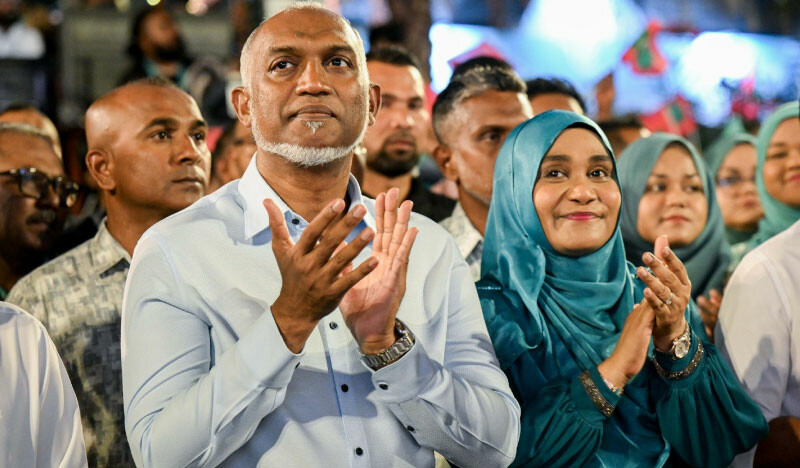
President Dr Mohamed Muizu (L) and First :ady Sajidha at the PNC Rally on Friday, November 14, 2025 | Photo: President’s Office
President Dr Mohamed Muizzu has used a mass rally in the capital to lay out a sweeping defence of his record in office and a broad policy agenda centred on stability, development and security, while promising tougher action on drugs, gangs, undocumented foreign workers and corruption.
Addressing thousands of supporters gathered at Artificial Beach in Malé on Friday night, the president described the event as “the largest gathering in the political history of the Maldives”, claiming around 13,000 people were in attendance.
advertisement

advertisement

Islam And ‘Maldives First’ Foreign Policy
Muizzu framed the Maldives as a “proud Islamic nation” and said serving Islam is the most important pillar of his policy. He cited mosque construction, the establishment of Quran centres on every island, waqf buildings, Zakat houses and free Hajj pilgrimages as examples of measures taken in office.
He said his government’s foreign policy is based on “Maldives First”, maintaining friendly ties with all countries except Israel. He defended the decision to ban Israeli passport holders, arguing that Maldivians do not want visitors from a state he accused of oppressing the Palestinian people.
“I received a lot of pressure when I tried to ban the passports. They said tourism would be destroyed,” he told the crowd, adding that as a democracy, the Maldives should act according to the will of its people. He said the country would not “welcome those who kill Palestinian people” to enjoy its beaches.
President Muizzu added that the government is strengthening defence forces and pledged that the public would see further benefits from foreign partnerships “in the form of aid, projects or other advantages”.
No Political Arrests And An ‘Independent’ Judiciary
The president reiterated his pledge that no one would be jailed in the Maldives for their political views under his administration and that there would be no “spirit of revenge” in government. He contrasted this with what he described as periods in the past when “everyone was in jail”.
He said his government has made the judiciary genuinely independent by providing a separate budget, opening a dedicated account for judicial finances and allocating what he described as the largest-ever budget for the courts. He noted the establishment of a new Criminal and Drug Court in Hulhumalé to help clear backlogged cases.
Muizzu insisted the executive would not interfere with judges’ decisions, but called on the judiciary to uphold justice and resist bribery or influence from drug networks, gangs and political figures. He said rule of law must apply equally to all and that he would not compromise on that principle.
Crackdown On Drugs, Gangs And Undocumented Foreign Workers
The president identified three major domestic problems: the drug epidemic, gang violence and the foreign worker issue.
He said that “just yesterday” the country had witnessed the largest anti-drug operation in its history, involving more than 500 police officers and the arrest of around 100 suspected traffickers. He said a bill proposing amendments to the Narcotics Act would introduce what he described as “the highest punishment in Islam” for those who import and traffic drugs.
While calling for harsh penalties for traffickers, he said youth addicted to drugs should be rehabilitated and reintegrated into society, adding that his government’s goal is to empower young people rather than leave them on the streets.
On gangs, Muizzu said a new law and tougher enforcement have reduced gang-related crimes by 49 percent compared with the previous administration. He linked this to efforts to move youths involved in criminal groups into training and lawful employment.
Turning to foreign workers, he claimed the issue had been neglected by all previous governments and allowed to grow “bigger and bigger”. Under the Huravee Operation, he said authorities have taken fingerprints of 191,723 foreign workers and now know who they are and where they live.
“After tomorrow, no foreign worker can stay in the Maldives without providing biometrics or digital identification,” he said.
Anti-Corruption Drive and ‘Maldives 2.0’ Digitalisation
Muizzu also pledged to confront corruption “without looking at anyone’s face or words”, saying the law would apply equally to major business figures, political leaders and others. He linked this to a wider plan to digitalise the entire state under the “Maldives 2.0” initiative.
The project, he said, will overhaul identity cards and the way public services are delivered, making systems faster, more efficient and more transparent, with the aim of reducing opportunities for graft and enhancing public trust.
Freedom of Expression ‘Within Islamic Bounds’
The president described freedom of expression as one of the most important elements in establishing stability but said it would only be guaranteed “within the bounds of Islam”. He stressed that there would be no political arrests, and said the government has increased the number of designated areas where people can assemble without seeking prior permission.
Health And Education as Pillars of Development
On development, Muizzu identified health as a central priority. He criticised previous governments for pursuing health policy “in name only” and argued that true development requires both preventive and curative care.
He defended bans on vapes, alleging they were being used to bring drugs into schools, and announced a generational ban on tobacco, under which people born on or after 1 January 2100 will be prohibited from buying or using tobacco products.
He said the largest share of next year’s budget and the greatest number of projects are allocated to the health sector, including new tertiary hospitals, laboratories on every island and a substantial expansion of the health workforce, after finding health facilities in many islands in disrepair.
In education, Muizzu said his government is implementing a comprehensive policy to tackle previously low pass rates, focusing on teacher training, infrastructure and resources. He said the aim is to develop young Maldivians who are proud of Islam, national history and identity, and who are capable of making decisions with the country’s interests in mind.
Spreading Development and Services Beyond Malé
Emphasising equality, the president said remote islands have long been neglected and should receive the same attention as Malé and city areas. He cited the introduction of ATMs, police services and plans for US dollar ATMs on 70 islands, as well as arrangements for ID cards and passports to be issued in every atoll rather than only in Malé.
He announced plans to build children’s parks, exercise gyms and fitness centres on every island, arguing that such investments are necessary to create a healthier, more equitable society.
According to Muizzu, 1,875 development projects are currently under way across the Maldives, of which 1,358 were initiated by the current government. He said further details will be shared with the public in coming days.
Major Housing Push and Land Reclamation
Housing, he said, remains one of the most pressing problems in Malé and across the country. Muizzu outlined a series of housing initiatives:
Private sector contracts signed for 8,520 housing units in 13 islands, with a similar number planned for 16 more islands in the next year.
He said reclamation of Giraavaru Falhu will begin soon, with a dredger scheduled to arrive later this month. He announced that criteria will soon be published and applications opened for 15,000 land plots, with the process expected to include Malé residents and those from other islands who have long lived in the capital.
Sectoral Advisory Bodies and Economic Management
The president said he plans to focus closely on tourism, fisheries and construction over the next two years, and will establish Presidential Advisory Committees for each sector. These bodies, he said, will include people from all levels, potentially including junior workers such as resort staff, and will provide a direct channel for sectoral issues and ideas to reach him.
Muizzu also claimed his administration has begun paying off unpaid bills inherited from the previous government. He said that, starting five weeks after taking office, the state has paid 444.3 million rufiyaa to around 140 parties, including contractors and suppliers, without resorting to printing money. He said payments due on next year’s sukuk have been included in the budget, and argued that the government is laying the groundwork for a more resilient economy.
Focus on Addu and Regional Equality
Highlighting Addu Atoll as the most populous region after the Malé area, Muizzu accused former governments of using its development as “bait”. He said his administration has already begun projects there, including initiatives to attract tourism, and has decided to keep Hulhudhoo and Meedhoo as separate islands with their own councils in line with residents’ wishes.
New Benefits For Seniors, Vulnerable Groups and Ramadan Relief
Looking ahead, Muizzu announced a series of policy changes and benefits for the coming year. These include:
A bill to allow people who wish to continue working between the ages of 65 and 75, extending their potential working life by ten years.
A monthly allowance of 10,000 rufiyaa for children with thalassemia, to be funded through the next budget.
Ramadan relief measures, including the distribution of canned fish and a cap of 400 rufiyaa on domestic-rate monthly utility bills during the holy month, with amounts above that level discounted.
He said these steps are intended to make society more caring and equal while easing the financial burden on households.
Call For Cooperative Local Councils
Muizzu urged voters not to allow the forthcoming Local Council Election to obstruct government projects and policies. He appealed to citizens to elect councillors and mayors who will cooperate with his administration and support the rapid implementation of initiatives already under way or planned.
“I want the projects that have been started and the ones that are to be started to proceed at full speed, without any opportunity for political wrangling,” he said, expressing confidence that the public would choose representatives aligned with the government’s pace and direction.
New Members Sign For PNC Before President’s Address
Earlier in the evening, just before the president took the stage, the ruling People’s National Congress held a membership signing segment, formally welcoming several new recruits to the party. Among them was Ahmed Mahloof, who previously served as Youth Minister in an MDP-led government and has now joined the PNC.