

Government Housing Scheme Criticised for Discriminatory Land Allocation
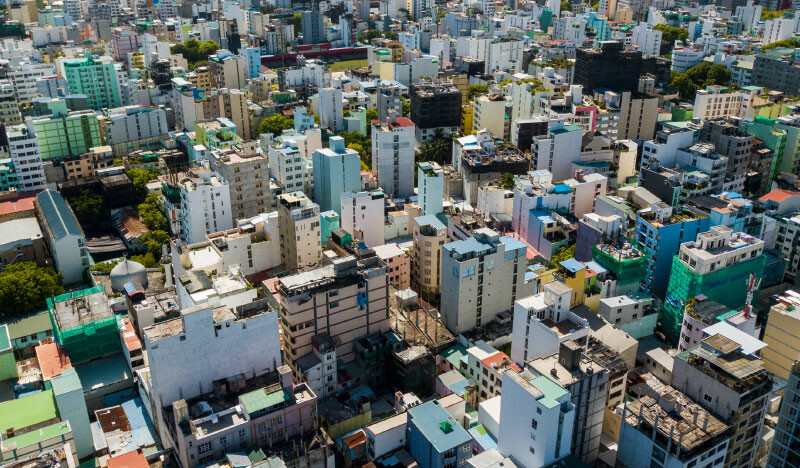
Malé aerial | Photo: MV+
The government’s housing scheme has been deemed discriminatory in its allocation of land for Malé ‘natives’ and Malé residents in the land allocation policy published yesterday.
The Residential Land for Malé Residents Policy, released by the Ministry of Construction, Housing and Infrastructure, outlines eligibility criteria for applicants aged 18 and above. The policy divides applicants into two groups: Malé ‘natives’ and long-term Malé residents.
advertisement

advertisement

According to Chapter Two, which details plot size and allocation zones, Malé ‘natives’ will be eligible for land in Rasmalé and the wider Greater Malé Region — including Malé, Vilimalé, Hulhumalé Phases 1, 2 and 3, Gulhifalhu, Thilafushi and Giraavalhufalhu. In contrast, long-term Malé residents will be allocated land only in Rasmalé. The policy does not specify where, within the Greater Malé Area, Malé ‘natives’ may receive land.
Malé natives are defined as:
a) individuals registered to a Malé address from birth;
b) individuals listed in the Malé registry without owning housing; or
c) individuals from other islands who later registered to a Malé address.
Long-term Malé residents are defined as individuals who have lived in the Malé area for more than 15 years.
In a separate notice, the Ministry outlined the number of land plots to be allocated according to applicant category:
- Those registered in Malé from birth will receive 7,000 land plots.
- Those who later registered a Malé address will receive 2,000 land plots.
- Those listed in the Malé registry without housing will receive 1,000 land plots.
- Long-term Malé residents will receive 3,000 land plots.
- People who are unable to inherit due to the death of a parent will receive 500 land plots
- People who own small plots on narrow roads and face challenges in developing them, and who agree to transfer their land to the government, will be allocated 1,500 land plots.
Although the Flat Allocation Policy for Malé Residents does not specify allocation areas, a separate notice outlines the distribution of flats:
- Those registered in Malé from birth will receive 2,500 flats.
- Those who later registered a Malé address will receive 500 flats.
- Those listed in the Malé registry without housing will receive 1,000 flats.
- Long-term Malé residents will receive 1,500 flats.
An additional 1,700 flats are allocated to specific groups, including people with disabilities, single parents with children under 18, Maldives Police Service employees, and military personnel. A further 300 flats are designated for employees from various state institutions.
While the policy fulfils President Dr Mohamed Muizzu’s pledge to provide both Malé natives and Malé residents with access to land and flats under his administration’s housing schemes, it appears to fall short of his repeated commitments to ensure fairness and avoid discriminatory distinctions between citizens.
Under the previous administration’s Binveriyaa scheme, long-term Malé residents were allowed to apply for plots in the Greater Malé Area in the second application round. However, the change in government occurred before allocations were finalised.