

Chinese Ambassador Urges Strengthened Development Planning Exchanges With Maldives
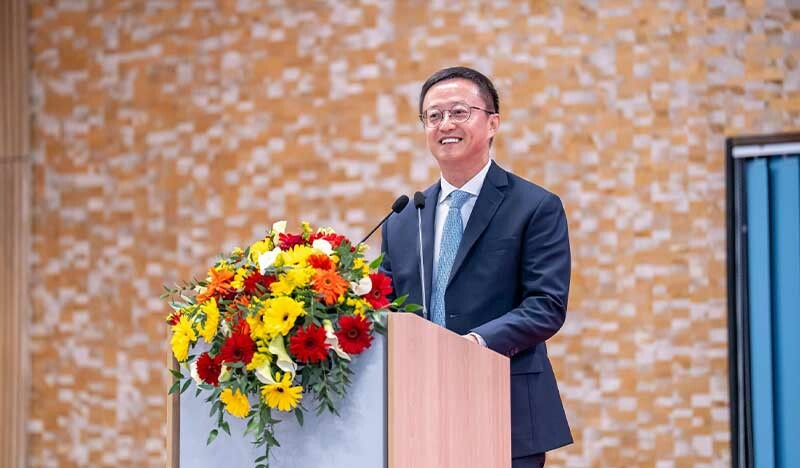
Chinese Ambassador to the Maldives Kong Xianhua has urged the Maldives and China to deepen exchanges on development planning to advance shared goals and strengthen long-term cooperation.
He made the remarks on Tuesday while delivering the keynote speech at the seminar titled Medium- and Long-Term Development Planning: The Key to National Modernisation.
advertisement

Ambassador Kong noted that the Maldives, under the leadership of President Dr Mohamed Muizzu, is formulating a 20-year national development plan aimed at achieving developed-country status by 2040. He said the medium- and long-term development visions of both countries share common values and objectives, and highlighted opportunities to expand collaboration through integrated planning.
He emphasised the importance of deepening cooperation in development strategy, referring to China’s transformation from a country struggling with poverty to becoming a global manufacturing hub, an innovation centre, and a major international market. He said the Maldives has also made substantial progress, rising from a least developed country to an upper-middle-income nation, becoming a leading tourism destination, and earning recognition as a front-runner in climate action. According to the Ambassador, aligning development strategies would help the two countries seize shared opportunities and strengthen mutually beneficial cooperation.
Ambassador Kong also called for greater economic integration, stating that China would continue to create new opportunities for global partners through its own growth. He highlighted major Chinese-supported projects in the Maldives, including the Sinamalé Bridge, as examples of how China’s economic advancement has facilitated development in partner countries.
He referenced a recent remark by Chinese President Xi Jinping during a meeting with United States President Donald Trump on 30 October, in which President Xi described the Chinese economy as “a vast ocean, big, resilient and promising.” Ambassador Kong expressed hope that the Maldives would join this “ocean of opportunities” to generate strong momentum for shared development.
The Ambassador identified China as a suitable partner for the Maldives in areas that are central to the country’s future development, including modern agriculture, infrastructure, the blue economy, the green economy, the digital economy, and artificial intelligence.
He also underscored the importance of strengthening people-to-people exchanges, recalling the 600-year history of friendship between the Maldives and China. He noted China’s continued status as the Maldives’ largest tourist source market for most of the past 15 years, except during the pandemic, and highlighted Chinese respect for the Maldivian people’s commitment to preserving national sovereignty and independence.
Ambassador Kong described education as a key pillar of bilateral relations. He pointed to China’s global leadership in STEM education and encouraged Maldivian youth to pursue studies in China to gain skills that could support national development. He cited ongoing programmes, including the visit of nine Maldivian students to universities and high-tech enterprises in Sichuan Province, and proposed the introduction of a “Chinese language + STEM” pilot initiative in the Maldives to help develop expertise in science, technology, and high-quality economic and social development. He said such initiatives would help strengthen the foundation for building a China–Maldives community with a shared future.