

PNC MPs Divided on Constituency Referendums for Expelled Parliamentarians
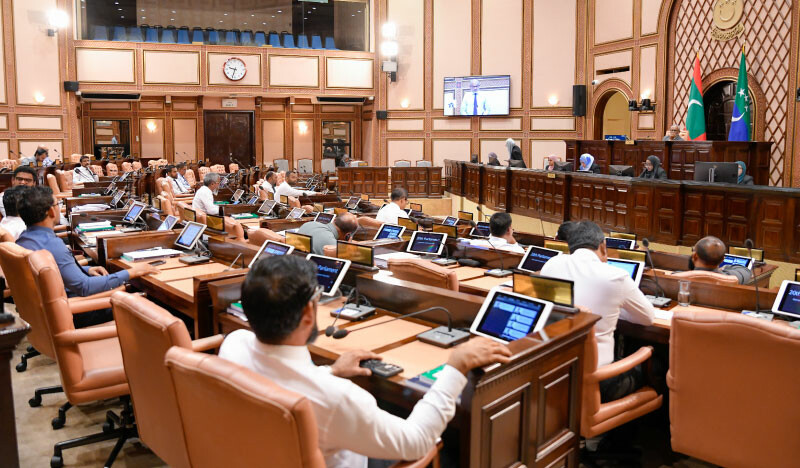
Parliament. | Photo: People’s majlis
The ruling PNC is divided over a government-backed constitutional amendment that would allow voters to decide whether MPs expelled from their political parties should retain their seats.
The amendment, submitted by Baarashu MP Ibrahim Shujau on behalf of the government, proposes that when an MP is dismissed from the party under whose ticket they were elected, a constituency referendum should be held. If a majority of voters support the MP’s removal, they would lose their seat. If the majority votes against removal, the MP would continue to serve as an independent member of the People’s Majlis.
advertisement

Ruling party leaders oppose recall mechanism
Inguraidhoo MP Ibrahim Falah, the majority leader, argued that MPs elected on party tickets owe their mandate primarily to the political parties that campaigned for them, and should automatically lose their seats if expelled.
“Since multi-party democracy was introduced, the President comes from a political party and most members also come through party tickets. Political parties do a lot of work to elect members to parliament, hence they should be respected,” he said, adding that he does not support the recall vote mechanism.
Feydhoo MP Ibrahim Didi echoed this view, noting that successive governments had supported anti-defection measures and that he, too, opposes the introduction of a recall vote.
By contrast, Shujau defended his proposal as a way of shifting power from party leaderships to the electorate.
He said the amendment is intended to “empower the people” and ensure that even when members are expelled from their parties, “it is up to the people to have the final say”, adding that this reflects the position of President Dr Mohamed Muizzu.
Central Hithadhoo MP Ahmed Azan also backed the change, saying parliamentarians must be accountable to their constituents. “With the amendment, the people will have the opportunity to remove them. It’s a good thing to do to set an example for the rest of the world in terms of democracy,” he said.
Funadhoo MP Mohamed Mamdhooh, from the ruling party, expressed mixed views. He said he does not support the recall voting mechanism, warning it would increase government spending, but backs provisions in the bill related to dissolving atoll councils.
Opposition notes similarities with earlier MDP position
Opposition MP Hussain Ziyad (Fittey) said the Maldivian Democratic Party (MDP) had previously opposed the automatic loss of seats when MPs are expelled from their parties and had itself proposed an amendment to change this.
He argued that the government’s proposal mirrors what the MDP had put forward earlier.
MDP MPs, however, raised concerns about the government’s decision to link the referendum mechanism and the dissolution of atoll councils in a single legislative package.
Hanimaadhoo MP Abdul Gafoor Moosa questioned how MPs should vote when they support parts of the bill but oppose others, and said combining such measures was contrary to parliamentary rulings. Speaker Abdul Raheem Abdulla rejected this, insisting the procedure complied with parliament rules.
Legal background and Supreme Court case
Under the current Constitution, Article 73 states that MPs automatically lose their seats if they are dismissed from the party under which they were elected. Last year, parliament—then led by the ruling party—passed a constitutional amendment reinforcing this clause, requiring members expelled from their parties to forfeit their seats immediately.
That revised clause has since been challenged at the Supreme Court. Former Kendhoo MP Ali Hussain filed a case seeking to nullify the article, triggering significant upheaval within the judiciary.
While the case was pending, the Judicial Service Commission suspended three Supreme Court justices ahead of scheduled hearings. In May, Justices Dr Azmiralda Zahir and Mahaz Ali Zahir were removed from office following an investigation, while the third suspended judge, Husnu Sood, resigned shortly afterwards.
Although new justices have since been appointed, the case remains unresolved. The government’s proposed amendment would introduce a new framework under which voters—rather than parties or automatic constitutional provisions—would decide whether an expelled MP continues to sit in parliament.
Next steps in parliament
At today’s sitting, MPs voted to accept the proposed constitutional amendments and related legislation, sending them to the Whole Committee for detailed review.
Shujau’s bill was accepted with the support of 56 MPs. Amendments proposed by Falah relating to the dissolution of atoll councils were also accepted, and a seven-member committee was formed to examine his proposals.
The committee, endorsed by Deputy Speaker Ahmed Nazim, comprises;
- Baarashu MP Ibrahim Shujau
- Central Mahchangolhi MP Ahmed Xamyr
- Thulhaadhoo MP Abdul Hannan Aboobakuru
- Velidhoo MP Mohamed Abbas
- Funadhoo MP Mohamed Mamdhooh
- Thoddoo MP Hussain Sameer
- Nilandhoo MP Fathimath Sauda