

Air Quality in Maldives Falls Below WHO Guideline, Data Shows
Health Protection Agency issues orange alert for Malé; yellow alert continues nationwide for air quality
Air quality levels across the Maldives have fallen below the World Health Organization’s (WHO) annual guideline for inhalable particulate matter, according to data from air quality monitor IQAir.
The WHO sets its annual guideline value for fine particulate matter (PM2.5) at 5 micrograms per cubic metre. However, IQAir data shows that PM2.5 levels around the Maldives currently stand at 12.5 micrograms per cubic metre, exceeding the recommended limit.
advertisement

advertisement

PM2.5 measures tiny particles in the air with a diameter of 2.5 micrometres or less. These particles originate from both natural and human-made sources, including emissions from power plants, waste burning, vehicle exhaust, smoke, soot and industrial processes. Due to their small size, PM2.5 particles can enter the bloodstream when inhaled, posing serious health risks.
Health experts warn that elevated PM2.5 levels pose a particular risk to people with chronic respiratory conditions. Long-term exposure can contribute to illnesses such as bronchitis, asthma and emphysema.
IQAir has currently classified air quality in the Maldives as “moderate” and issued a yellow-level alert. In response, the Health Protection Agency (HPA) has advised individuals with respiratory conditions to avoid outdoor exercise during this period. The agency also recommends wearing N95 or equivalent masks outdoors, keeping doors and windows closed, and using air purifiers indoors to reduce exposure.
IQAir categorizes air quality into six levels: good, moderate, unhealthy for sensitive groups, unhealthy, very unhealthy and hazardous. On 10 December, air quality in Malé deteriorated to an orange level, classified as unhealthy for sensitive groups.
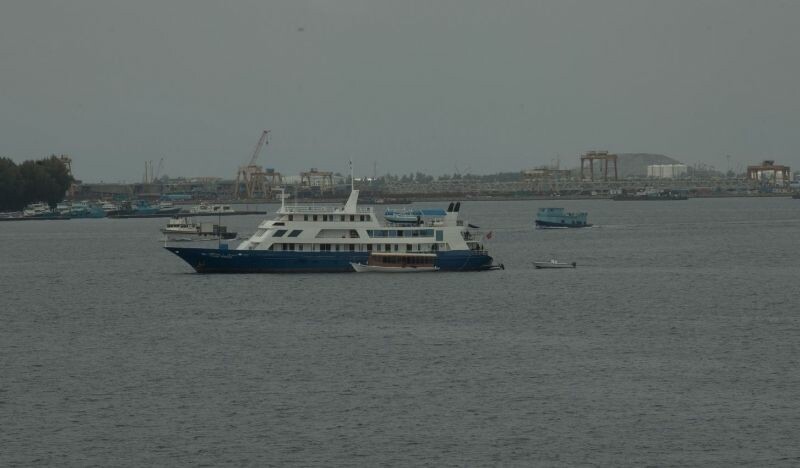
Meteorologist Hussain Waheed attributed the decline in air quality in Malé to the mixing of wind currents during seasonal transitions, which has reduced visibility. He said this year recorded some of the poorest visibility levels seen in Malé in recent years.