


NFIS 2026–2030 Targets Broader Financial Inclusion Across the Maldives
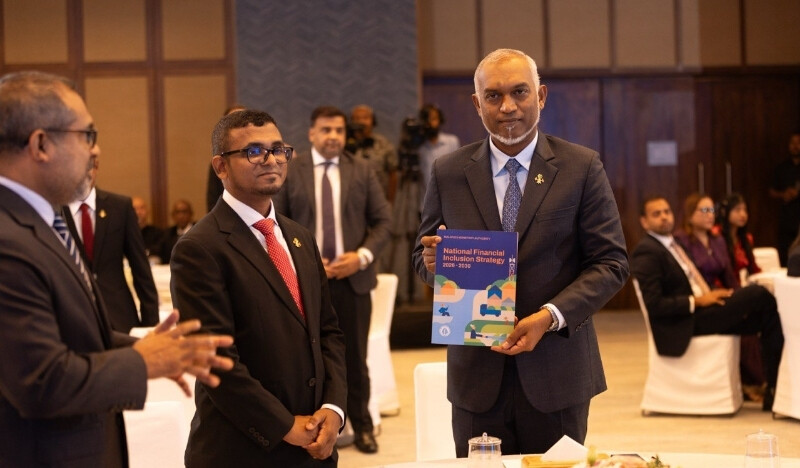
Launching of NFIS 2026. | Photo: MMA
The Maldives Monetary Authority (MMA) has unveiled a new National Financial Inclusion Strategy for 2026 to 2030, setting out plans to widen and deepen access to financial services across the country while addressing long-standing structural gaps.
The strategy acknowledges that although about 91 per cent of Maldivian adults have a bank account, many do not use financial services regularly or effectively. Women, older people, young citizens and micro, small and medium-sized enterprises (MSMEs) remain among the groups most excluded from meaningful participation in the financial system. The new approach shifts emphasis from account ownership alone to resilience, sustainability and greater use of financial products.
advertisement

advertisement

Geographic dispersion remains a key challenge. With more than 1,200 islands, maintaining physical banking services outside the Greater Malé region is costly. While mobile internet penetration is close to 90 per cent, digital financial services have not been adopted evenly. Fewer than 40 per cent of people aged 65 and above use mobile banking, and levels of basic financial literacy remain low among several segments of the population.
The strategy also highlights gender-based disparities. Women are more likely than men to remain unbanked and are significantly less likely to access credit from formal institutions. For MSMEs, unmet demand for private sector lending is estimated at MVR 11.1 billion, driven largely by limited collateral options and informality in business practices.
Climate vulnerability features prominently in the plan. Although many citizens recognise the importance of financial tools that support climate resilience, the uptake of insurance and other risk-mitigation products remains limited.
To address these issues, the NFIS is built around five pillars. The first focuses on improving access to finance, including alternative credit scoring based on utility and telecommunications payment records, and the establishment of a central collateral registry to allow movable assets to be used as security. Expanding housing finance options for first-time buyers in the Greater Malé region is also prioritised.
The second pillar centres on Islamic finance, aiming to broaden inclusion for individuals who avoid conventional banking. Proposed measures include incorporating social finance instruments such as Zakat and Waqf into financial products, alongside initiatives to strengthen public awareness and understanding of Islamic finance.
Digital finance forms the third pillar, seeking to better leverage widespread mobile use. Plans include improving interoperability between banks and payment providers, enabling cross-border payments through system integration, and introducing a centralised electronic know-your-customer platform to streamline account opening.
Inclusive green finance is addressed under the fourth pillar. This includes developing a national green taxonomy, creating frameworks for carbon credit markets linked to protected areas, and offering technical support and grants to MSMEs adopting environmentally sustainable practices.
The fifth pillar focuses on consumer empowerment and financial literacy. Financial education will be integrated into school curricula, and a formal consumer complaints mechanism will be established to ensure transparent and timely resolution of disputes with financial institutions.
Implementation will be supported by reforms to financial infrastructure, legal and regulatory frameworks, and partnerships across government, the private sector and civil society. Oversight will be provided by a National Financial Inclusion Steering Committee, co-chaired by the MMA and the Ministry of Finance, with technical committees aligned to each pillar.
Several priority actions are scheduled to begin early in the strategy period. These include establishing the consumer redress mechanism and passing new laws on credit information and secured transactions in 2026, followed by the rollout of green finance initiatives and cross-border payment integration by 2027.
Through the NFIS 2026–2030, authorities aim to create a more inclusive, resilient and digitally enabled financial system tailored to the Maldives’ economic and geographic realities.