


95% of Malé at Risk of Flooding by 2100, Report Warns
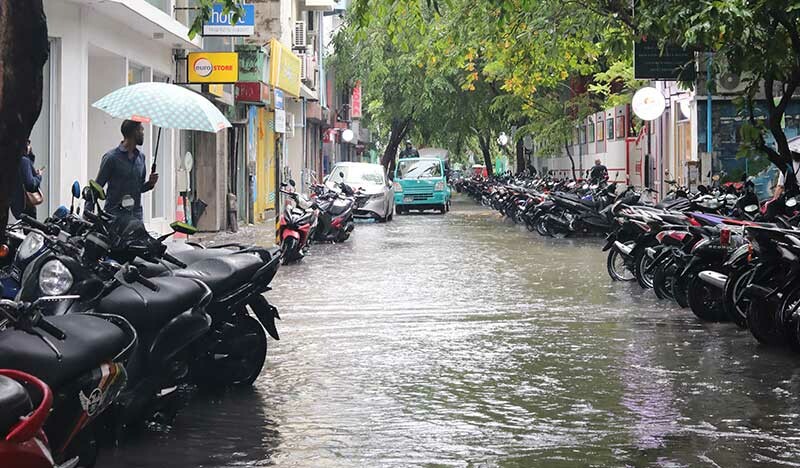
Heavy Rains Cause Flooding in Male City | Photo: MV+
Ninety-five per cent of Malé’s land area could be at risk of flooding by 2100 due to sea-level rise and urban flooding, according to a new study by the Malé City Council in collaboration with the United Nations Economic and Social Commission for Asia and the Pacific (ESCAP) and Local Governments for Sustainability (ICLEI).
The report highlights escalating climate threats facing one of the world’s lowest-lying capital cities and calls for urgent, city-wide climate action.
Sea-level rise and urban flooding
Malé and Vilimalé sit just one metre above sea level, leaving them highly exposed under Intergovernmental Panel on Climate Change (IPCC) projections. Hulhumalé, reclaimed at around two metres above sea level, faces a comparatively lower risk.
The study notes that frequent tidal swells are already damaging coastal housing and disrupting ferry services, while torrential rainfall regularly overwhelms the capital’s drainage systems, causing widespread flooding across the densely urbanised island.
Heat stress in a dense city
Limited green space — less than three per cent vegetation cover — combined with dense concrete development has intensified the urban heat island effect. Daytime “real-feel” temperatures in Malé often reach 35–40°C, increasing health risks, reducing outdoor mobility, and driving up energy demand for cooling.
Lack of climate planning and data
Despite mounting risks, Malé has yet to develop a greenhouse gas (GHG) emissions inventory or a city-level climate adaptation and mitigation plan, the study finds. While the City Disaster Management Plan, developed with the National Disaster Management Authority, addresses emergency response, it does not cover climate adaptation.
Although seawalls and the elevated development of Hulhumalé offer some protection, the report warns that these measures are insufficient without comprehensive, long-term planning.
Strengthening urban resilience
The study recommends that the Malé City Council work with the Ministry of Infrastructure to introduce flood-resistant construction standards and identify disaster-prone sites such as schools, mosques and hospitals. It also calls for partnerships with local NGOs and the private sector to green the city using native plants, alongside stronger early warning systems and community outreach to improve preparedness.
Aligning climate action and cutting emissions
The report urges the council to coordinate with the national government to develop a local climate action plan aligned with the Maldives’ Nationally Determined Contribution (NDC 3.0). It also recommends establishing a city-level, IPCC-compliant GHG inventory and monitoring system to track emissions from energy, transport, waste and water sectors.
Public awareness and climate-proofing development
Further recommendations include integrating climate education into school curricula, promoting public participation through environmental incentive schemes, and screening all major infrastructure and housing projects for climate risks. The study also calls for prioritised investment in drainage, coastal protection and renewable energy to strengthen Malé’s long-term resilience.