


Supreme Court Upholds Anti-Defection Constitutional Amendment
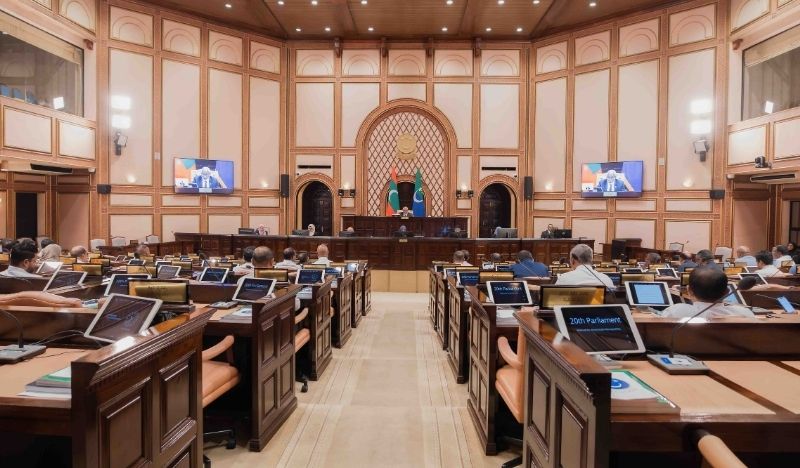
Parliament on March 8, 2026 | Photo: Parliament
The Supreme Court has ruled that the constitutional amendment resulting in the loss of parliamentary seats for members who resign or are dismissed from their political party does not conflict with the constitutional framework.
The ruling was issued today in a case filed by former Kendhoo MP Ali Hussain, who sought to have the amendment declared unconstitutional. He additionally requested in the case to that even if the amendment were found to be valid, its principles would not apply to the members of the current sitting Parliament.
Ali Hussain argued that the amendment conflicted with Articles 26, 75, and 90 of the Constitution. He also contended that the amendment undermines the presidential system based on the separation of powers and requested the court to declare it void and without constitutional authority.
Delivering the court’s opinion, Chief Justice Abdul Ghanee Mohamed said Parliament holds the authority to amend the Constitution and stated that the amendment does not violate constitutional sovereignty when considered alongside principles adopted in democratic nations.
He said there was no basis to conclude that the amendment was void or unconstitutional.
The Chief Justice referred to rulings from courts in countries with presidential, parliamentary, and hybrid systems regarding anti-defection laws. He also noted that a similar law introduced in the Maldives in 2017 had previously been upheld by the Supreme Court.
He further stated that the amendment would apply to the current 20th Parliament.
Five other judges on the bench supported the Chief Justice’s opinion. Justice Aisha Shujoon Mohamed was the sole dissenting judge.
In her dissenting opinion, Justice Shujoon said the amendment should be invalidated, arguing that MPs are elected based on individuals and should prioritise the interests of the people.
The bench hearing the case included Chief Justice Abdul Ghanee Mohamed, Justice Aisha Shujoon Mohamed, Justice Ali Rasheed Hussain, Justice Dr Mohamed Ibrahim, Justice Hussain Shaheed, Justice Abdulla Hameed, and Justice Mohamed Saleem.