

‘Real Crisis Behind Declining Birth Rates Is Young People Unable to Build Families They Want’
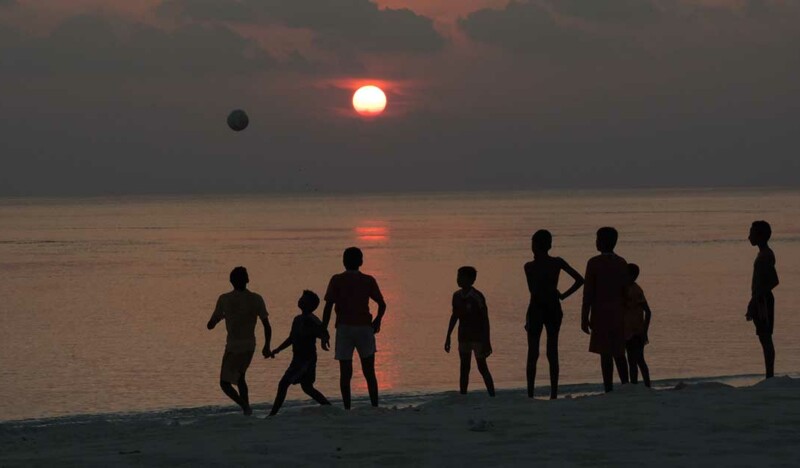
Children play football on the beach in B. Eydhafushi as the sun sets over the sea | Photo: MV+
The real crisis behind declining birth rates is not falling fertility itself, but the growing number of young people who are unable to build the families they want because of economic hardship, limited support systems and barriers to reproductive choice, according to a joint opinion piece released by the UN Population Fund (UNFPA) Maldives and the Maldives Bureau of Statistics to mark World Population Day.
The article, written by UNFPA Maldives Country Director Kunle Adeniyi and Maldives Bureau of Statistics Chief Statistician Aishath Hassan, says public debate has increasingly focused on declining fertility rates and fears of population decline, while overlooking the reasons many people are unable to have the number of children they want.
advertisement

Citing findings from the recently published Socio-Economic Drivers of Low Fertility report, the authors said high living costs, housing shortages, work-life balance challenges, gender inequality and health issues are among the key factors influencing reproductive decisions in the Maldives.
The article states that the cost of living, particularly in the Greater Malé region, has made raising children increasingly expensive, with many families relying on two incomes to meet daily expenses. It also notes that thousands of people migrate to Malé each year in search of employment and better access to services, contributing to population concentration in the capital while many outer islands continue to lose residents.
Women Bear Disproportionate Burden of Care
The authors said balancing employment and family responsibilities remains a significant challenge, particularly for women, citing concerns over job security, limited workplace flexibility and inadequate childcare support. They also note that women continue to carry almost all unpaid care responsibilities, with 99 per cent of care work in the Maldives performed by women.
The article highlights changing attitudes among younger generations, with many prioritising higher education and career development before starting families. It also points to emotional stress, rising divorce rates and limited institutional support as factors discouraging some women from having additional children. According to the report, around 16 per cent of Maldivian women aged between 18 and 25 consider having no children to be their ideal family size.
Changing Priorities and Health Concerns
Health concerns, including infertility, Polycystic Ovarian Syndrome (PCOS), obesity, and high Caesarean section rates, are also identified as contributing factors. The authors say many women reported negative experiences during pregnancy and childbirth, affecting their willingness to have more children.
Call for Coordinated Population Policy
It calls for a range of policy measures, including the development of a national population policy, expanded family-friendly housing, stronger maternity and paternity protections, improved childcare services, greater access to fertility treatment and reproductive healthcare, measures to promote a more equal sharing of unpaid care work, and increased investment in youth employment, housing and mental health.
According to the authors, addressing low fertility should focus on removing the barriers that prevent people from making free and informed reproductive choices, rather than pursuing policies aimed solely at increasing birth rates.