

Solar Hybrid Power Systems Launched Across 25 Islands in Raa and Baa Atolls
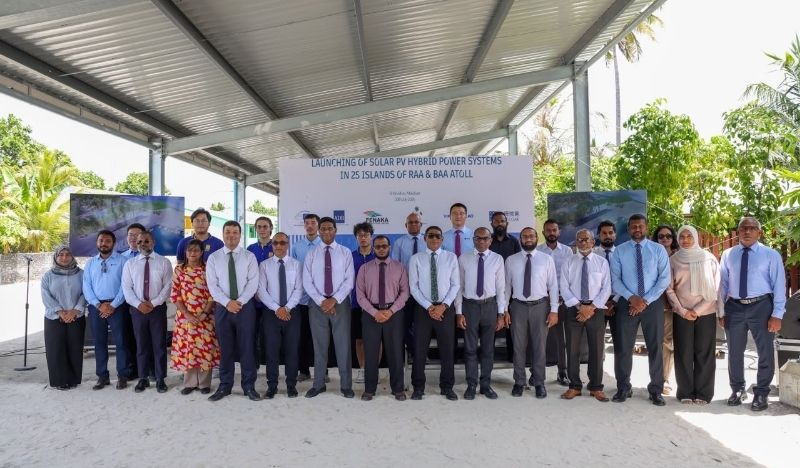
Photo: Ministry of Climate Change, Environment and Energy
The government has launched solar photovoltaic (PV) hybrid power systems across 25 islands in Raa and Baa atolls, adding 6.36 megawatts (MW) of solar capacity and nearly 10 megawatt-hours (MWh) of battery storage to the national renewable energy network.
The systems were inaugurated in Raa Atoll Kinolhas today under the Preparing Outer Islands for Sustainable Energy Development (POISED) project, implemented with support from the Asian Development Bank (ADB) and the European Investment Bank (EIB).
advertisement

The newly commissioned systems are expected to generate 10.4 gigawatt-hours of clean energy annually, while saving more than three million litres of diesel each year. The project is also expected to reduce carbon dioxide emissions by approximately 8,400 tonnes annually.
According to the Ministry of Climate Change, Environment and Energy, the POISED project aims to transition diesel-based power generation systems across 160 islands to solar PV hybrid systems. With the completion of the latest phase, work has been completed on 97 islands.
Across these islands, the project has established a combined 19.8MW of solar PV capacity and 20.6MWh of battery energy storage. The systems are supported by energy management systems and necessary electricity grid upgrades.
The project has also provided 27MW of diesel generator capacity to support power generation alongside the renewable energy systems.
The latest phase covers 13 islands in Raa Atoll and 12 islands in Baa Atoll. The largest solar PV systems include those installed in Raa Atoll Meedhoo, with 450.45 kilowatts peak (kWp), and Baa Atoll Maalhos, with 396kWp.
Work is currently ongoing on a further 23 islands and is expected to be completed in 2027.
The project forms part of the government’s efforts to reduce reliance on imported diesel and expand renewable energy generation. The government has set a target of generating 33 per cent of the electricity used in the Maldives from renewable sources by the end of 2028, in line with a key target under the country’s Nationally Determined Contributions.