

MDP Manifesto Pledges Establishment of SME Islamic Bank
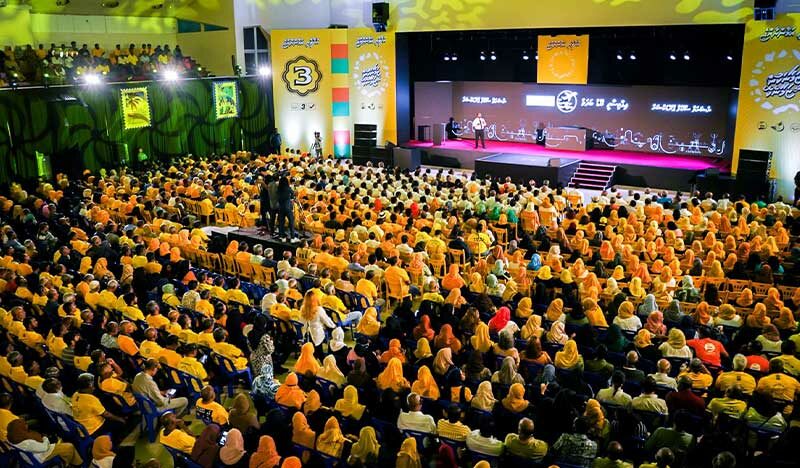
Photo: MDP
The Maldivian Democratic Party (MDP) has put forward a proposal in its manifesto to establish an SME Islamic Bank, which would offer Islamic financial services alongside other banking facilities.
During the campaign event held on Thursday, President Ibrahim Mohamed Solih unveiled his economic manifesto and policy, marking the conclusion of the five-point plan outlined in his election manifesto.
advertisement

According to the details outlined in the MDP manifesto released on the same evening, the plan entails the creation of a new Tier-1 SME Islamic Bank. This institution would provide Islamic financial services and other relevant offerings in accordance with Shariah principles.
Additionally, efforts would be made to enhance the stock market’s functionality, enabling businesses and investors to maximize the advantages of the financial market. The manifesto aims to extend Islamic financing options specifically tailored for small businesses and introduce a broader range of financial products.
Among the proposed measures, enhancements to the regulatory framework are highlighted. These measures are designed to offer greater financial support and protection to small businesses.
This would be achieved through the simplification of lending criteria for banks, the introduction of an alternative credit scoring system for businesses, and the provision of increased financial assistance and safeguards for small enterprises. The policy further outlines plans to expand services by establishing branches of the SME Development Finance Corporation across the nation.
In addition to these initiatives, the manifesto outlines the introduction of innovative financial products, including green finance for eco-friendly businesses such as those involved in renewable energy. Moreover, a “crowd funding mechanism” is slated to be established through a separate platform, connecting small and medium enterprises as well as startups with potential investors.
In a bid to provide financial aid to the smallest businesses, the scope of financing without guarantees and equity is set to be expanded. Furthermore, microfinancing schemes are on the horizon to extend financial assistance to a broader demographic, with a special emphasis on supporting women and youth engaged in home-based work.
The manifesto envisions the expansion of existing grant programs specifically catering to individual and domestic workers, aiming to elevate their status and opportunities. Additionally, the plan advocates for the expansion of business incubation and accelerator programs, which would furnish administrative, technical, innovative, and financial support.
To bolster the business environment, the policy emphasizes the need for more expansive spaces such as an SME hub, which would accommodate low-cost businesses. Additionally, provisions are made for online businesses operating in the international arena to make payments in US dollars as merchant currency.
In a move to alleviate burdens on small businesses and self-employed individuals, the policy proposes exempting businesses earning less than MVR 2 million from goods and services tax and income tax.
A streamlined presumptive tax system, designed to be special, compliance-friendly, and administratively efficient, is also envisaged. The policy further seeks to reduce fees for all local businesses by introducing modern payment services through government channels.