

Nasheed Advocates Domestic Solutions Over IMF Programme
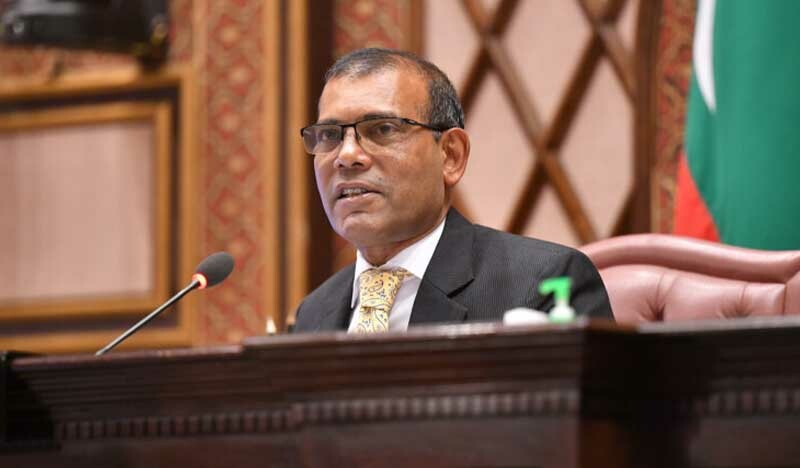
Photo: People’s Majilis
Former President Mohamed Nasheed has commented on the economic situation in the Maldives, asserting that countries within the Climate Vulnerable Forum (CVF), including the Maldives, may not necessitate involvement in the International Monetary Fund’s (IMF) programme to address economic challenges.
CVF countries need not go into IMF programs to overcome debt distress. The CVF-V20 Secretariat will facilitate technical support for member countries to identify opportunities to reduce debt, such as debt-for-climate & environment swaps and carbon trading. @TheCVFadvertisement

Nasheed conveyed his views via a post on ‘X’ last evening, amid circulating speculation on social media regarding the Maldives’ purported consideration of an IMF bailout package due to economic strain.
In his statement, Nasheed highlighted that the Maldives, as a CVF member, could seek assistance from the CVF-V20 Secretariat, emphasising potential avenues such as carbon trading and ‘debt-for-climate and environment’ swaps to alleviate debt burdens and procure technical support.
Notably, Nasheed’s tenure as President saw the Maldives engaging in an IMF program in 2011 aimed at stabilising the country’s financial landscape, a move that faced considerable political hurdles, including the implementation of measures such as civil service reductions and tax reforms.
Contrary to circulating rumours, Economic Minister Mohamed Saeed dismissed claims of acute economic distress necessitating an IMF bailout, asserting that the Maldives’ economic trajectory remains robust, surpassing initial growth projections.
Saeed reiterated the government’s commitment to its fiscal reform agenda, endorsed by the IMF, aimed at mitigating economic vulnerabilities by prudently managing public debt and financing mechanisms.
Following a recent visit by an IMF delegation to the Maldives, it was disclosed in a statement that despite challenges posed by the Covid-19 pandemic, the Maldivian economy has exhibited signs of recovery, with a projected growth rate of 5.2% for the current year, albeit lower than the previous year.
The IMF commended the Maldivian government’s proactive fiscal measures, emphasising the country’s capacity to address economic challenges internally without resorting to external assistance, such as an IMF bailout package.
It is worth noting that participation in an IMF program typically entails stringent austerity measures, potentially resulting in significant domestic spending cuts, including reductions in civil service staffing, underscoring the government’s preference for domestic solutions to economic challenges.