

Dollar Rate Holds Steady Amid High Demand Period, Says Economic Minister
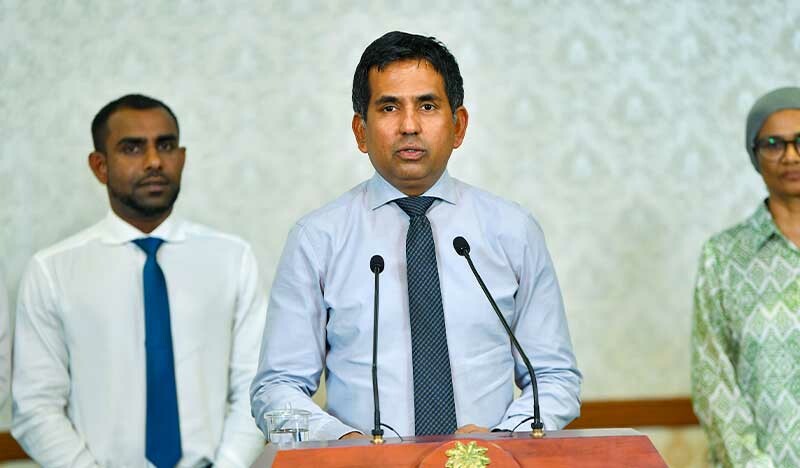
Photo: The President’s Office
Minister of Economic Development and Trade, Mohamed Saeed, has announced that the country has maintained stability in the dollar exchange rate, marking a significant improvement in its economic condition since the current administration took office.
Attributing the progress to strategic measures and concerted efforts initiated under President Dr Mohamed Muizzu’s guidance, Saeed highlighted the nation’s recovery from its economic challenges, particularly evident since November of last year.
advertisement

“Demand for foreign currency has remained high, particularly with the Umrah pilgrimages and increased imports during Ramadan. Despite this, the dollar rate has either held steady or even decreased further,” stated Saeed.
He underscored that this achievement was a result of swift and forward-thinking measures, such as discontinuing public account overdraw, implemented under the President’s leadership.
“We are now focusing on targeted efforts and planned measures for the future. As a result, we anticipate further improvement in the dollar rate in the near future,” remarked Saeed.
Saeed disclosed that a key aspect of the state’s strategy is to enhance foreign currency inflows into the country. He highlighted an agreement with the globally renowned energy trader, Vitol, to commence bunkering operations in the northernmost atoll of Ihavandhippolhu (Haa Alif), aiming to diversify the economy beyond tourism.
This initiative, facilitated by the State Trading Organization (STO), seeks to reduce the country’s reliance on tourism and expand into other industries.
The announcement follows Saeed’s earlier commitment to kickstart bunkering services in Ihavandhippolhu by July, as revealed during his recent visit to the atoll.
The practice of printing large amounts of currency annually to cover state expenses was terminated last December. Subsequently, the administration introduced a robust fiscal reform agenda to manage costs and address debts.
This reform agenda, which garnered praise from the International Monetary Fund (IMF), includes strategies to reduce unnecessary expenditure, such as scaling back on hosting extravagant ceremonies and overseas trips.