

Adversarial Journalist Aaidh Quits Journalism, Points to Mental and Financial Pressures
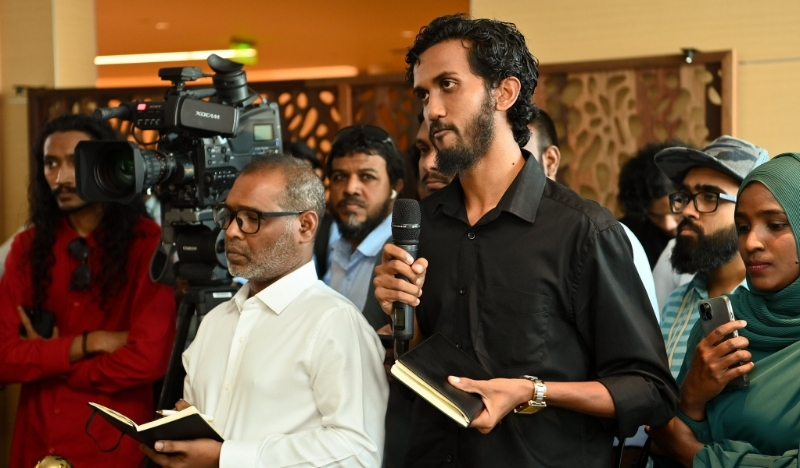
Ahmed Aaidh, a journalist known for his adversarial reporting and sustained scrutiny of government policy and political figures, has announced that he is stepping away from journalism, citing the mental, personal and financial pressures of the profession. He described the move as a “difficult” decision reached after considerable reflection.
In a post shared on X, Aaidh said he had made the “difficult decision” to step away from journalism following “much reflection”, describing his time in the field as among the most formative of his life.
“The years I have spent in this field have been among the most formative and defining of my life,” he wrote. “Journalism challenged me, shaped my worldview, and gave me experiences I will carry long after this chapter ends.”
Aaidh spent three and a half years at Adhadhu, where he was known for reporting that frequently scrutinised government policies and political figures. His work often placed him at the centre of contentious national debates.
In his statement, Aaidh cited the personal, mental and financial pressures of the profession as factors behind his decision. “Passion can take you far, but eventually you have to look at the personal, mental, and financial realities and ask whether the equation still makes sense,” he wrote.
While Aaidh did not specify his next role, his departure has fuelled speculation online that he may be taking up a position within a state-owned company. The reported move has drawn criticism from some commentators, who have questioned whether journalists who have built reputations on adversarial reporting should subsequently enter government-linked employment.
In his post, Aaidh addressed what he described as “recent rumours, indirect remarks, and creative theories” surrounding his departure. “From political actors, speculation is hardly new,” he wrote, adding that he was more disappointed by fellow journalists who, he suggested, had not sought clarification before commenting publicly.
He also apologised to anyone who may have felt negatively affected by his reporting, stating that he had aimed to uphold “professionalism, integrity, and fairness”.
Aaidh thanked his colleagues at Adhadhu and expressed gratitude to sources “across the social and political spectrum of the Maldives” who had entrusted him with their stories.
“While I leave journalism, I do so with deep respect for the profession and those who continue this important work,” he wrote.
His departure comes amid ongoing debates about the sustainability of journalism in the Maldives, including concerns about financial pressures on newsrooms, online harassment and the career stability of media professionals.