

Agreement Signed for Solar Battery Energy Storage System Installation in 24 Islands
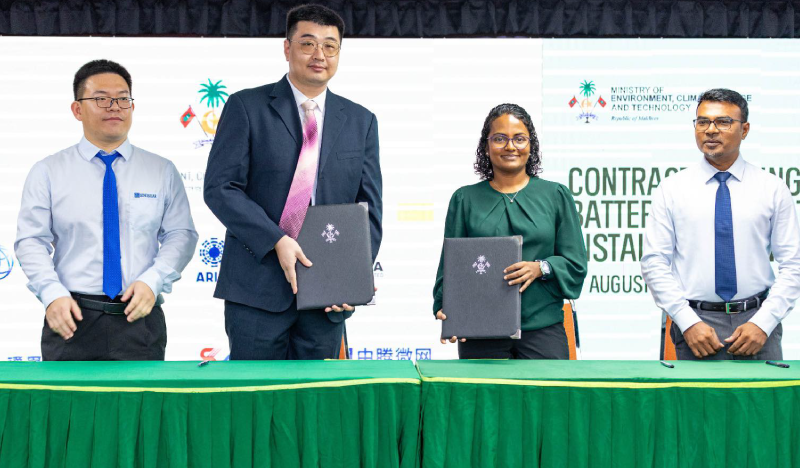
Photo: Ministry of Environment, Climate Change and Technology
The Ministry of Environment, Climate Change and Technology, in collaboration with the World Bank, signed an agreement for the installation of 40 MWh battery energy storage systems across 24 islands.
This venture falls under the name of the Accelerating Renewable Energy Integration and Sustainable Energy (AREISE) project.
The signing took place at the Islamic Center, where Minister of Environment, Climate Change and Technology, Aminath Shauna, officially signed the agreement on behalf of the Ministry. Wang Peitao, Senior Project Manager, represented the contracting party by signing on its behalf.
advertisement

advertisement

advertisement

The joint venture company responsible for the project comprises China National Technical Import and Export Corporation, Guodian Nanjing Automation Co., Ltd., and Sino Solar Hybrid (Beijing) Technology Co., Ltd.
The islands designated for the installation of the battery energy storage systems are: L. Fonadhoo, L. Gan, L. Dhanbidhoo, L. Isdhoo, L. Kalaidhoo, L. Maabaidhoo, L. Maamendhoo, L. Kunahandhoo, L. Hithadhoo, L. Maavah, Fuvahmulak City, Kulhudhuffushi City, GDh. Thinadhoo, B. Eydhafushi, LH. Hinnavaru, LH. Naifaru, GA. Vilingili, SH. Funadhoo, S. Hithadhoo, S. Feydhoo, S. Maradhoo-Feydhoo, S. Maradhoo, S. hulhudhoo, and S. Meedhoo.
Under the AREISE project, the 40 MWh battery energy storage system is envisioned to stockpile surplus electricity generated from solar energy sources.
This reservoir of renewable energy not only aids in regulating grid stability, but also plays a pivotal role in mitigating instances of power outages during periods of heightened demand, particularly when the demand-to-supply ratio surpasses the 30% threshold.
Complementing the installation of the 40 MWh battery energy storage systems, the AREISE initiative will oversee the setting up of a cumulative 36 MW of solar power systems across the selected islands.
The project’s scope extends to a revamp of the electricity grid in those island regions designated for the deployment of solar and battery systems.
An essential facet of such endeavors, which are executed with foreign assistance, is the reduction of the government’s reliance on conventional fuel sources, thereby fostering electricity generation in an environmentally responsible manner.
Central to the nation’s energy aspirations is the ambitious target of attaining net-zero emissions by the year 2030. This overarching goal symbolises the country’s commitment to a sustainable energy trajectory and responsible environmental stewardship.