


Civil Society Groups Accuse State of Institutionalising Environmental Destruction
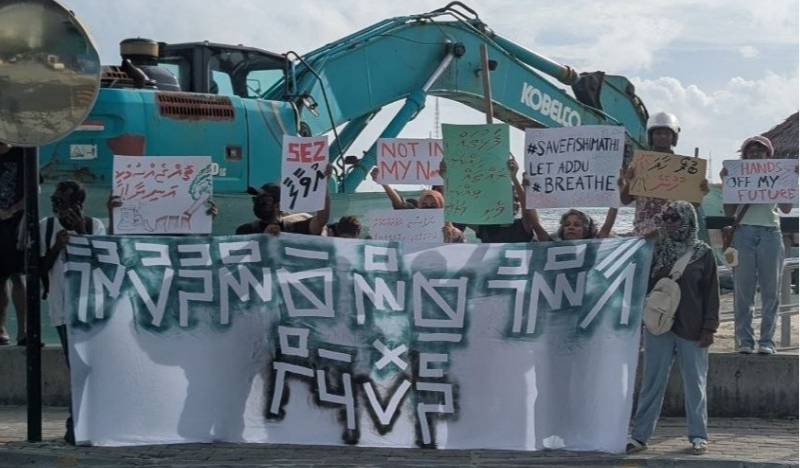
Scene from protest held on June 5, on World Environment Day by civil society organizations. | Photo: Save Maldives
Environmental organisations have accused successive Maldivian governments of systematically dismantling environmental protections, warning that the country’s coral reefs, mangroves and protected areas face an unprecedented threat from weakened oversight and politically driven development decisions.
In a joint statement released on yesterday on World Environment Day, Ecocare Maldives and Transparency Maldives, together with 33 civil society organisations, said the Maldives is witnessing an “institutional assault” on the environment through legal and regulatory changes that have undermined environmental safeguards.
advertisement

The groups argued that environmental governance has been progressively weakened over the years, but said recent measures have transformed the erosion of oversight into formal policy. They cited the dissolution of the semi-autonomous Environmental Protection Agency’s (EPA) governing board, amendments to environmental impact assessment regulations, the approval of development activities in protected areas and the reopening of shark fisheries as examples of what they described as a systematic rollback of environmental protections.
JOINT PRESS STATEMENT: The Systematic Dismantling of Environmental Protection in the Maldives@TransparencyMV and @ecocare_mv alongside civil society organisations and community groups across the country, are raising this alarm — we cannot stay silent. pic.twitter.com/Ql5YWqAxPy— Transparency MV (@TransparencyMV) June 5, 2026
The statement called on authorities to restore the independence of the Environmental Protection Agency (EPA), repeal or suspend the sixth amendment to Environmental Impact Assessment (EIA) regulations, and reinstate public consultation and comprehensive environmental review requirements for projects in ecologically sensitive areas.
The organisations also urged the government to halt the road extension project at Addu Nature Park, protect the boundaries of Eidhigali Kilhi and Koattey wetlands, preserve Villimalé’s Funavaa tree grove and reimpose a full ban on shark fishing.
According to a briefing note accompanying the statement, amendments introduced in April 2024 weakened regulations governing reclamation and dredging by removing buffer zones around islands and lagoons and allowing protections to be overridden by the President’s Economic Council.
The groups also criticised Presidential Directive No. 14/2025, implemented last year, which dissolved the EPA’s governing board and placed the agency directly under ministerial control. They argued that while previous administrations had overridden environmental authorities on individual projects, the latest changes had formally reduced the agency’s independence.
The statement further raised concerns about amendments to EIA regulations that allow the Cabinet to bypass review timelines and public consultations for projects designated as national priorities. The groups said some infrastructure and housing projects are now exempt from environmental assessment requirements.
Concluding the statement, the NGOs called for investigations into alleged corruption linked to land reclamation projects, greater transparency in environmental decision-making and stronger protections for environmental defenders.