

Democrats Challenge Court’s Jurisdiction in MDP’s Constitutional Case
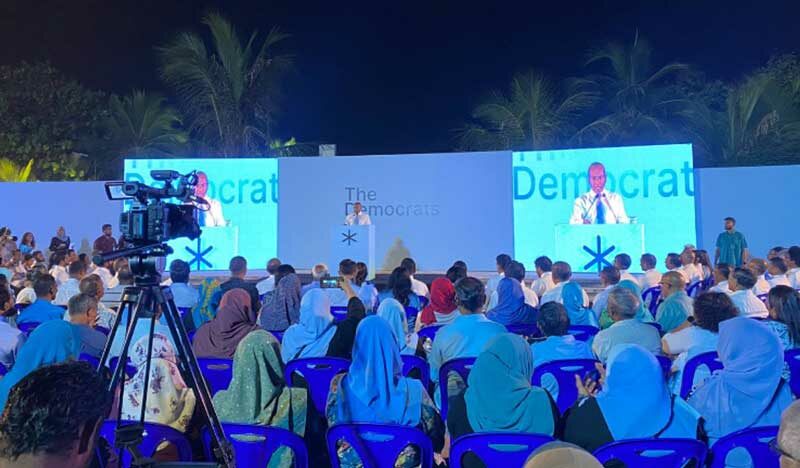
In a hearing held today, The Democrats made assertions regarding the jurisdiction of the Supreme Court to address a constitutional challenge initiated by the MDP (Maldivian Democratic Party) regarding the interpretation of the Rules of Parliament.
The Democrats, who have interceded in the MDP’s constitutional case concerning the no-confidence motion against the Speaker of Parliament, expressed their belief that, from a procedural standpoint, the Supreme Court lacks jurisdiction to hear the case.
Abdhullah Shairu, granted the opportunity to intervene in the case, yesterday, requested additional time to review the documentation submitted by the MDP, Parliament, and the PPM/PNC.
Presided over by Justice Mahaz Ali Zahir, a five-judge bench declared another hearing scheduled for 9:00 am the following day, subsequently adjourning the current hearing.
During today’s proceedings, Counsel General Fathmath Filza highlighted the parliamentary regulations indicating that the Deputy Speaker should oversee a motion of no confidence in the Speaker, suggesting that the rules could be amended if necessary.
Filza argued that Article 82 of the Constitution stipulates the Speaker should not preside over such a motion but contended that the Rules of Parliament indicate a contrary intention, thereby resolving any conflict of interest.
She further iterated that despite the MDP’s perspective that the current parliamentary situation obstructs further progress, she believes there are no impediments to conducting routine parliamentary sessions.
Filza pointed out that, as per the Parliament rules, the impeachment motion has not yet been tabled during a House session.
During the hearing, the Attorney General’s Office, representing the prosecution, urged the court to ascertain whether the parliament’s rules were misinterpreted, resulting in the cessation of parliamentary activities.
Former Attorney General Azima Shakoor, advocating for the PPP/PNC, raised procedural concerns, highlighting the discordance between the Attorney General’s stance and that of the parliament. This objection, however, was not acknowledged by the Bench.
As a respondent, Azima emphasised that the Parliament has been at a standstill since June, which coincided with the conclusion of a presidential election.
She, along with the Attorney General, opined that the parliamentary inactivity was due to unconstitutional interpretations by the Parliament, prompting no action on the matter.