


Filladhoo Publishes Tourist Dress Code; Swimwear Restricted to Beaches
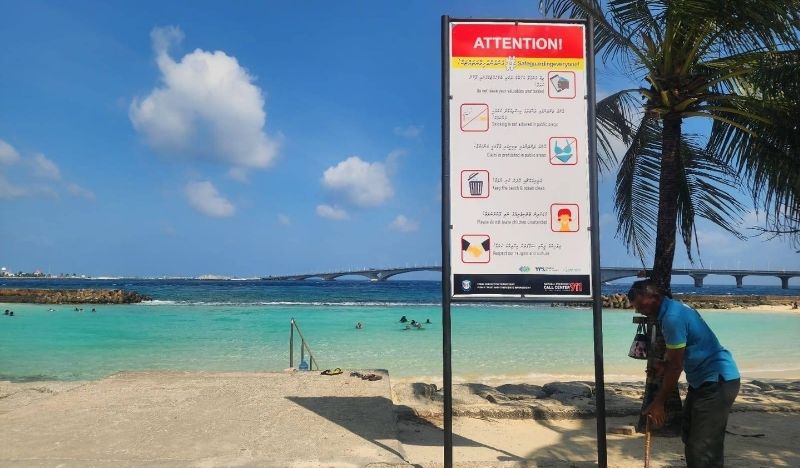
Information board for tourists in Artificial Beach, Malé, showing that bikinis are restricted at the public beach | Photo: Malé City Council
The Filladhoo Island Council in Haa Alifu Atoll has published a dress code for tourists in the government gazette, limiting swimwear to designated beach areas.
The council said the code aims to provide clear guidance on appropriate attire for visitors while promoting Islamic principles and cultural values on an inhabited island. The regulation outlines separate guidelines for men and women.
Under the dress code, women are required to wear tops that cover the shoulders and chest in public areas. Tank tops, crop tops, and bikini-style tops are only permitted at designated tourist beaches. Sheer or revealing clothing, including cover-ups, is also restricted to these areas. Skirts, dresses, and shorts should ideally extend to the knee or below, and visitors are advised to avoid overly revealing or tight-fitting clothing in public spaces. Swimwear is limited to designated beaches, guesthouse pools or private accommodation areas.
For men, shirts or T-shirts are required in public areas, with going shirtless allowed only at designated beaches or swimming areas. Shorts should ideally reach the knee, while swimwear is restricted to approved beach and swimming locations. The council also advised against wearing overly revealing clothing, such as very short shorts or tight singlets, outside beach areas.
In its introduction, the council stated that the Maldives is a 100 percent Muslim country where daily life is guided by Islamic principles, cultural values, and national laws. It noted that Filladhoo, as an inhabited island, upholds these traditions and expects visitors to respect local customs and lifestyle.
The council said the dress code is based on national laws and regulations requiring visitors to respect local customs and social norms on inhabited islands, as well as local governance practices aimed at maintaining community standards and social harmony.
It added that the council may advise visitors on appropriate attire and expects compliance with the guidelines. Repeated non-compliance may result in restricted access to certain public areas.
The council said visitors are welcome to the island and encouraged them to respect local customs, Islamic values, and national regulations to ensure a positive experience for both residents and guests.