

Former President Yameen Backs Away from Death Penalty Citing Judicial Mistrust
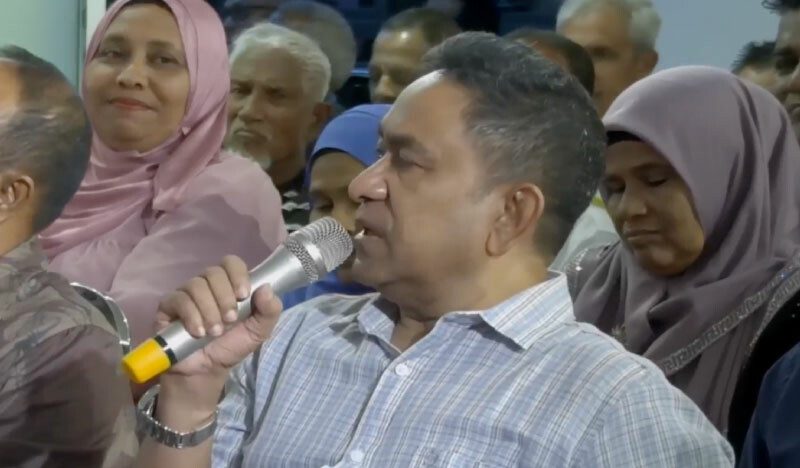
Former president Abdulla Yameen
Former Maldivian president Abdulla Yameen has declared that he no longer supports the enforcement of the death penalty, saying he has lost confidence in the country’s judiciary.
Speaking at a People’s National Front (PNF) gathering at his residence, Yameen said that while he had previously endorsed executions, he now questions whether any head of state could carry out capital punishment under present circumstances.
“I have supported that in the past. However, today I am choosing not to. I have no confidence in the judges,” he told supporters.
He added that while the Supreme Court’s verdicts are final, some rulings “cannot be trusted”, and stressed that restoring public faith in judicial decisions was essential.
His remarks come as the government of President Mohamed Muizzu has pledged to move forward with implementing the death penalty, including proposals to extend it to drug trafficking offences.
The Maldives has not carried out an execution since 1952. A long-standing moratorium effectively ended in 2014 during Yameen’s presidency, when new regulations permitted capital punishment for certain offences, including murder. The rules also curtailed presidential powers to pardon those sentenced to death. In 2016, the government confirmed that executions would be conducted by hanging and prepared facilities at Maafushi Prison. That same year, the Supreme Court upheld the death sentence of Hussain Humaam Ahmed, convicted of killing MP Afrasheem Ali in 2012. The ruling prompted concern from human rights organisations, which questioned the fairness of the trial and raised allegations of coerced confessions.
Yameen’s administration had pledged to carry out executions within 30 days of Supreme Court confirmation, but despite repeated announcements in 2017 that the practice would resume, no executions took place.
The current government has revived discussion on capital punishment. In July this year, President Muizzu confirmed his intention to introduce the death penalty for drug trafficking. The proposal has drawn criticism from both domestic rights groups and international organisations, which argue that flaws in the judicial system make fair implementation impossible.
Yameen, who now leads the recently established PNF after leaving the Progressive Party of Maldives–People’s National Congress coalition, has added his voice to those concerns. He emphasised that while governments are obliged to enforce court rulings, he did not believe it was the president’s responsibility to oversee executions without broader judicial reform.
Yameen’s change of stance marks a significant departure from his policies while in office and could shift the national debate on capital punishment. His comments place renewed attention on the independence and accountability of the judiciary, an issue repeatedly raised by human rights groups since the 2014 regulatory changes.