

Fuvahmulah City Launches Pilot Multi-Hazard Early Warning System
Efforts are underway to establish a Multi-Hazard Early Warning System in Fuvahmulah City, aimed at strengthening preparedness for climate-related disasters and minimising their impact.
The initiative is led by the government through the World Bank-funded Digital Maldives for Adaptation, Decentralisation, and Diversification Project (D’MADD) and implemented by the Ministry of Homeland Security and Technology.
advertisement

advertisement

advertisement

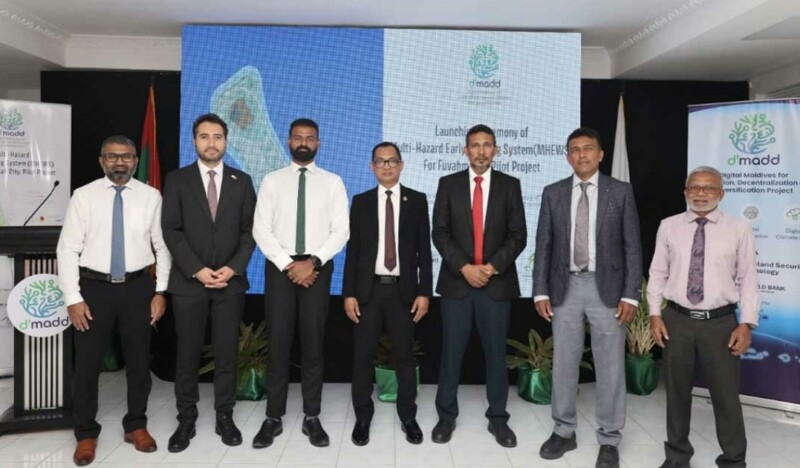
The inauguration ceremony was attended by the Minister of State for Homeland Security and Technology, Dr Mohamed Kinaanath. The pilot project is designed to support the President’s commitment to advancing climate change research and monitoring using new technology, in line with the Maldives 2.0 vision and the nation’s digital transformation agenda.
Dr Kinaanath emphasised that the success of the system depends on cooperation between agencies, enhanced training for staff, and active community engagement. The system is expected to reduce disaster risks to the environment and protect society. He noted that, while the system is currently in its pilot phase, it is designed to be scaled up and fully implemented as part of a national disaster preparedness plan, incorporating decentralisation, digital tools, and inclusive participation.
Highlighting the vulnerability of island nations to climate-related disasters, Dr Kinaanath said climate change has led to sea level rise, erosion, and sea swells, which affect multiple aspects of daily life. The system is being developed in collaboration with the University of Salford in the United Kingdom.
As part of the pilot, the Mobilise Platform software, developed by the THINKlab at the University of Salford, integrates Fuvahmulah’s geographic features and estimates potential damage based on satellite and IoT weather data. The system will enable the City Council and the Meteorology Office to assess risks in real time, issue early warnings to the public, and implement immediate precautionary measures.
The first phase of the project will focus on rapid disaster risk assessments, identifying vulnerable groups, and designing island-specific response protocols. Following completion of the pilot in two phases, a living lab will be established at the Fuvahmulah City Council. The University of Salford has agreed to extend system support for three years after the project’s completion under the D’MADD project.
The inauguration was also attended by Fuvahmulah Mayor Ismail Rafeeq, Environmental Regulatory Authority Chief Executive Hassaan Mohamed, World Bank Country Economist and Resident Coordinator Ardem Ataş, and Professor Terence Fernando of the University of Salford, who delivered a presentation on the system’s features.