


Government Submits Bill to Revise Evidence Act, Expanding Court Powers on Media Source Disclosure
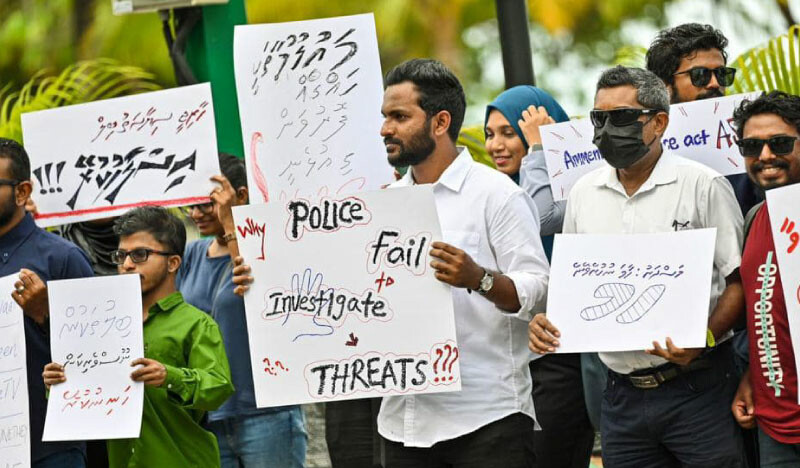
Journalists stage a protest in Malé on May 3, 2023, to highlight the challenges and restrictions facing press freedom in the Maldives. | Photo: MJA
The Maldivian government has introduced a bill to Parliament seeking to amend the Evidence Act, expanding the powers of the courts to compel journalists to reveal confidential sources under specific conditions.
The amendment, submitted by Bilehdhoo MP Ahmed Aslam on behalf of the government was introduced in today’s sitting. It outlines that the High Court will hold the authority to issue orders compelling journalists to reveal confidential sources, with rulings required within 24 hours of submission. Under the current Evidence Act, lower courts also have power to issue such orders.
advertisement

advertisement

advertisement

According to the amendment, journalists and media outlets would be given the opportunity to respond to any disclosure request, and any decision made by the High Court could be appealed to the Supreme Court within 10 days. The provision specifies that an application for disclosure can only be made to the High Court by the Prosecutor General, the accused, or the defendant, and only under circumstances outlined by law.
The Evidence Act, enacted in January 2023 under the administration of former President Ibrahim Mohamed Solih, currently protects journalists from being forced to reveal their sources without the consent of the person who provided the information. However, Article 136 of the Act allows exceptions in cases related to terrorism or national security, where the court may order disclosure at the request of investigators, the Prosecutor General, or the defendant.
At the time of its passage, journalists had expressed concern over the lack of a clear definition for “national security threats.” Critics argue that the new amendments still do not address this ambiguity.
MP Aslam’s proposed amendment reaffirms that journalists who have been assured confidentiality cannot be compelled to reveal their sources, except when it is deemed essential to identify or apprehend a suspect in a criminal case. In such instances, the Prosecutor General’s Office or the accused could request a court order for disclosure.
The 2023 Evidence Act sparked widespread protests from journalists and media advocates, who said the legislation compromised press freedom. Although the previous administration made certain revisions before passing the bill, many media representatives argued that the final version worsened protections for journalists.
The current government has previously pledged to review and address journalists’ concerns about the disclosure provisions. The introduction of this latest amendment comes shortly after the implementation of a new Media Regulation Act last month, which has also drawn criticism.
The media law prompted protests from journalists, opposition parties, and civil society groups, with several international organisations — including the United Nations, European Union, United States, United Kingdom, International Federation of Journalists (IFJ), Reporters Without Borders (RSF), and Committee to Protect Journalists (CPJ) — calling for its repeal.
The proposed Evidence Act amendment is expected to reignite debate over press freedom and the balance between national security and the protection of journalistic sources in the Maldives.