


Government to Submit Death Penalty Bill This Parliamentary Session
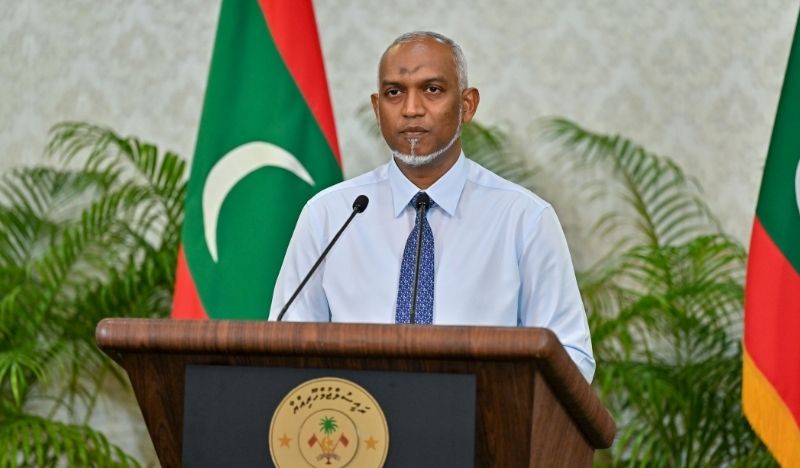
President Dr. Mohamed Muizzu holds the second press briefing of 2026 on 23 March 2026. | President’s Office
The Attorney General’s Office is in the final stages of drafting legislation to establish a legal framework for implementing the death penalty in the Maldives, President Dr Mohamed Muizzu has said.
Speaking at a weekly press conference at the President’s Office today, Dr Muizzu stated that capital punishment cannot be introduced through regulations alone and must instead be enacted through an Act of Parliament. He confirmed that the proposed bill will be submitted during the current parliamentary session.
“The Attorney General’s Office is preparing a bill to bring in a special law to implement the death penalty for such persons. The bill is now in the final stage,” he said.
The President added that, in his view, once all legal processes and appeals have been completed, the head of state does not have the discretion to indefinitely delay executions.
“It is not a choice for the head of state to keep a person who has completed all the stages without executing him,” he said.
Dr Muizzu also indicated that a number of individuals are currently awaiting execution after exhausting all stages of the judicial process.
He further highlighted amendments to the Drug Act approved by Parliament in December, which include provisions for the death penalty. These provisions, however, can only be enforced once the proposed legislation is enacted. Under the amendments, capital punishment would apply in cases involving more than 350 grams of cannabis, more than 250 grams of diamorphine (heroin), or over 100 grams of any other illicit drug, excluding cannabis and diamorphine.
The Maldives has not carried out an execution since 1952. In 2014 during the presidency of Abdulla Yameen, regulations were introduced permitting capital punishment for certain offences, including murder. Those rules also limited presidential powers to grant pardons in death penalty cases.
In 2016, authorities confirmed that executions would be conducted by hanging and prepared facilities at Maafushi Prison. In the same year, the Supreme Court upheld the death sentence of Hussain Humaam Ahmed, who was convicted of the 2012 killing of Member of Parliament Afrasheem Ali.
Although the administration at the time pledged to carry out executions within 30 days of Supreme Court confirmation and made several announcements in 2017 indicating that executions would resume, no execution was ultimately carried out.