


Gov’t Introduces Housing Bill that Prohibits Lease of Social Housing Units to Third Parties
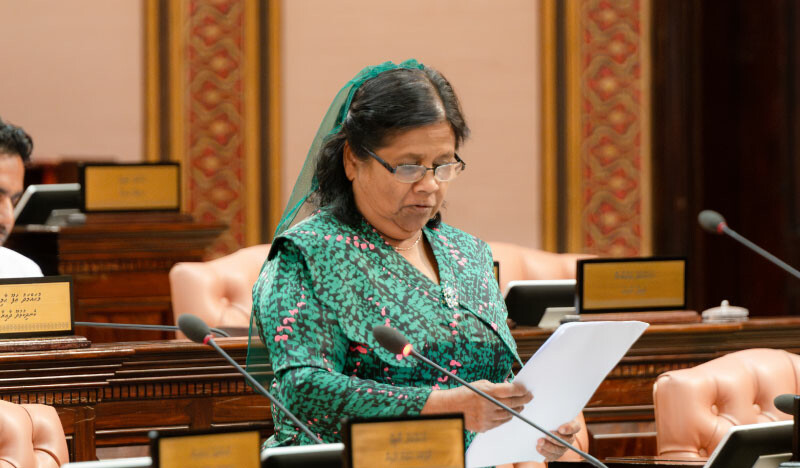
MP for Central Maafannu constituency, Asma Rasheed, speaking at the parliament on April 23 | Photo: Parliament
MP for Central Maafannu constituency, Asma Rasheed, submitted a Housing Bill on behalf of the government last week that prohibits the lease of social housing units to third parties.
The parliament discussed the bill today, with many parliamentarians acknowledging the need for such legislation that will regularise and work towards fixing the housing crisis the Maldives faces. The initial discussion for this bill was held on April 23.
advertisement

advertisement

advertisement

A major area of focus in this bill is social housing, how they are allocated, and the transfer of social housing units. Article 58 of the bill prohibits leasing of social housing units to a third party.
Additionally, Article 59 of the bill details how the ownership of a social housing unit may be transferred:
- The ownership of the housing unit can only be transferred to a spouse or a child of the owner, if the child is of age
- The ownership can be transferred only if the unit has been fully paid for
However, if the ownership of a social housing unit is transferred, the person who lets the unit go cannot apply for another social housing scheme, unless they qualify for the criteria of additional regulations that will be made under this bill.
Non-compliance with this act can be fined up to no more than MVR 50,000, depending on the offence. If an offence is repeated, in addition to the initial fine, an additional fine of MVR 25,000 can be imposed.
All Housing Projects Must Be Registered
Commenting on Article 11 of the bill, which requires all housing projects in the Maldives to be registered with the ministry, MP for South Hulhumale’ constituency Dr Ahmed Shamheed raised concerns about whether this provision would apply to private citizens building on their own land.
“When the housing project is interpreted, it is unclear whether private individuals, private parties building on their state land (bandaara land) or private land, are required to register under the Act,” he said.
The purpose of registering housing projects is to ensure they are carried out responsibly and in a transparent manner, Article 11 (b) of the bill states. All housing projects carried out in the Maldives will have to be registered with the government within 90 days of the act being implemented.
Housing Fund to Be Introduced
This bill proposes establishing a housing fund to provide assistance for those without a place to live or for families without the financial means to find appropriate housing. This fund is to be established within 90 days after the law is implemented.
The purpose of this fund is as follows:
- Facilitating government-run housing projects targeting those who do not have a suitable place to live.
- Providing housing loans to find or build suitable living spaces for families with less financial resources who do not have a suitable place to live.
Money for this fund will be allocated from the state budget, foreign financial aid, and additional financing that is approved by the governing board. Additionally, money from government-run housing projects for those who do not have a place to live will also be allocated for this fund.
Housing Registry to be Established
This bill requires the ministry to establish a housing registry that maintains an updated list of citizens in need of housing. Citizens may apply to be included in the registry by submitting evidence of their income, expenses, and any other information the ministry requests.
The ministry must verify and keep the submitted information accurate and up to date, in case the circumstances of the citizens change as well.
The Housing Bill’s discussion today concluded when the parliament took its break for lunch. The members returned after lunch to discuss issues relating to parliamentary committees.