


Gov’t Submits Bill to Parliament to Increase Tourist and Airport Taxes

Photo: MV+
The government has introduced three key bills to Parliament, aiming to raise revenue through increased tourist and airport taxes as the legislative body reconvenes after its recess today.
One of the bills, sponsored by West Maafannu MP Mohamed Musthafa Ibrahim, seeks to amend the Goods and Service Tax Act by raising the Tourism Goods and Service Tax (TGST) from 16% to 17% starting in June next year. The amendment is presented as a measure to stabilise the state’s financial health and debt. The bill estimates this adjustment will generate an additional MVR 201.9 million in TGST revenue for the following year.
advertisement

advertisement

advertisement

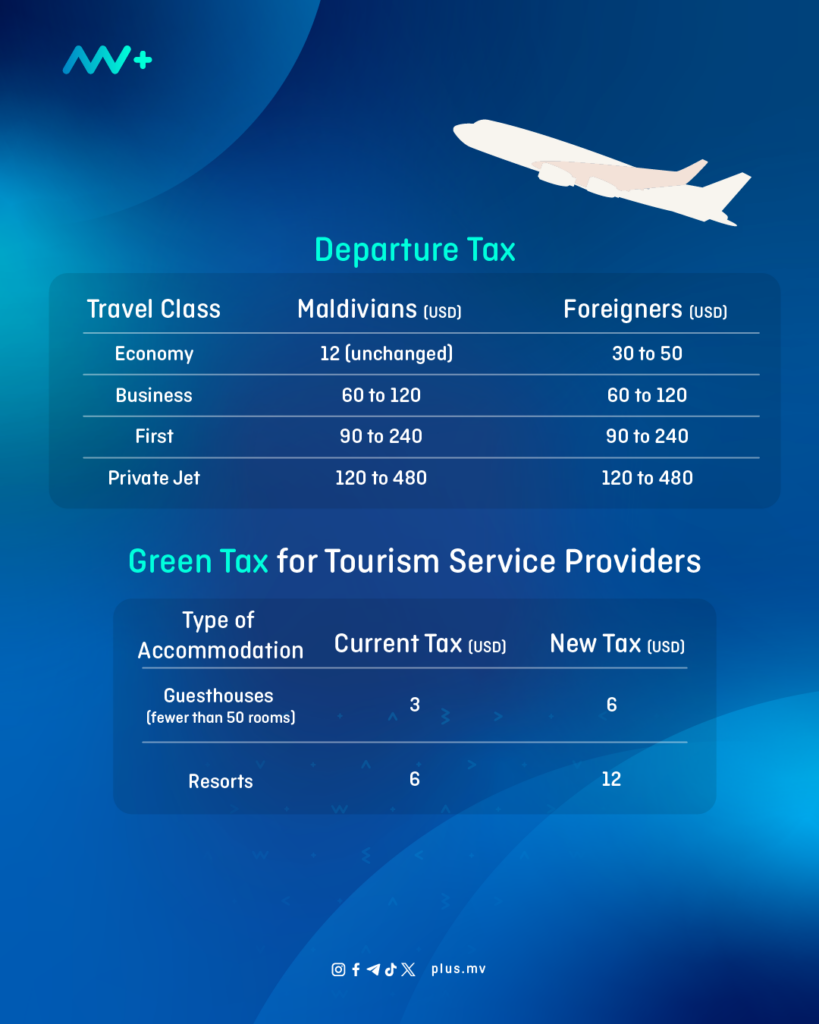
South Mahchangolhi MP Musthafa Hussain introduced a second government-backed bill proposing an amendment to the Tourism Act. This amendment seeks to double the Green Tax levied on tourists. If passed, the tax will increase to USD 12 per day for tourist establishments currently charging USD 6, and to USD 6 per day for those charging USD 3. These adjustments are projected to bring in MVR 963.6 million in additional revenue.
A third bill, introduced by Gemanafushi MP Asadhulla Shihab, proposes amendments to the tax on outbound travellers departing from Maldivian airports. While the departure tax for Maldivian citizens travelling in economy class will remain at USD 12, the bill suggests raising the fee for foreign travellers in the same class from USD 30 to USD 50, with corresponding increases for business and first-class tickets and private jet travel. The bill also recommends raising the Airport Development Fee at the same rate as the departure tax, projecting combined revenues of MVR 769.5 million and MVR 809.8 million, respectively.
The government has stated that these measures are necessary due to the challenges the Maldives faces in managing its debt levels, echoing recent concerns raised by the World Bank regarding delays in fiscal reforms.
Alongside these proposed tax changes, new regulations now require all tourism revenue to be deposited in local banks. This policy has sparked criticism among tourism industry stakeholders, who argue that it may affect business operations.