

Island Votes Defy Party Lines, Reflecting Polarised Views of Key Political Figures
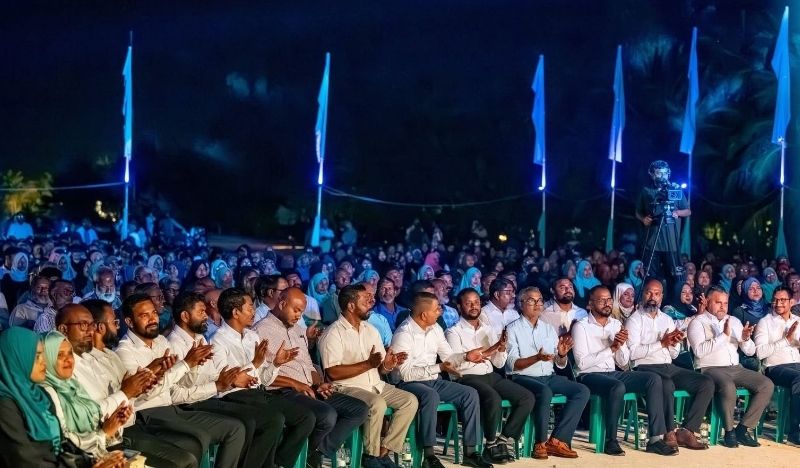
Campaign launch event in Kulhudhuffushi City on 6 February 2026. | Photo: PNC
Constituents in several islands linked to prominent political figures voted against the parties represented by their own leaders in recent local council elections, highlighting a growing polarisation in public attitudes toward political figures across the country.
According to the Local Council and Women’s Development Committee (WDC) elections 2026 results shared on the Elections Commission of the Maldives (ECM) website, in Gaaf DhaalFaresmaathodaa, the home island of Vice President Hussain Mohamed Latheef, voters backed Maldivian Democratic Party (MDP) candidate Mohamed Sabah, who secured 54% of the vote against a Progressive National Congress (PNC) candidate. However, the council member seat was won by a PNC candidate, while the women’s reserved seat went to MDP, reflecting a split mandate. MDP won the majority of the local council seats over the ruling party PNC.
A similar trend emerged in Meemu Dhiggaru, associated with Deputy Speaker Ahmed Nazim. There, MDP’s Ahmed Nishan won the council presidency with 61% of votes, defeating a PNC candidate, while MDP also secured both the council member and women’s reserved seats.
In Maamigili, the home island of Maamigili MP and Jumhooree Party leader Qasim Ibrahim, results also defied expectations. While a JP candidate narrowly secured the council presidency, both the council member seat and the women’s reserved seat were won by candidates from the Progressive National Congress (PNC). Historically, council seats on the island have consistently been held by JP candidates, making the outcome a notable shift in voter preference.
In Eydhafushi, represented by MP Ahmed Saleem, an independent candidate delivered an upset, with Shamee Ibrahim securing 41% of the vote to defeat a PNC-affiliated candidate. However, the council member seat was won by a Progressive National Congress (PNC) candidate.
Meanwhile, in Mahibadhoo, the constituency of PNC-aligned MP and President of Football Association of Maldives (FAM) Ahmed Thoriq, an MDP candidate won the council presidency with 57% of the vote, defeating PNC’s Rashad Ali.
In contrast, Baa Kendhoo, represented in parliament by MDP MP Mauroof Zakir, swung in favour of PNC. Ahmed Shan of PNC won the presidency with 55% of votes, with the party also taking both the council member and women’s reserved seats.
In Alif Alif Thoddoo, where MDP MP Hussain Sameer serves, voters elected PNC candidate Adam Naveen with 51% of the vote, with the party also securing the council member seat.
The trend continued in Rasdhoo, a hub for local tourism and traditionally an MDP-leaning island. PNC candidate Ahmed Waheed won the presidency with 50% of votes, defeating an MDP candidate, while PNC also secured both the council member and women’s reserved seats.
In Maafushi, another island historically favourable to MDP, the island where the model for the current local tourism was born during the first MDP presidency, PNC’s Ali Shamoon won the council presidency with 54% of votes against both MDP and independent candidates. The council member seat was claimed by an independent candidate, while the women’s reserved seat went to MDP.
Despite mixed outcomes at the island level, candidates from the MDP secured all mayoral seats and an overwhelming majority in both council positions and Women’s Development Committee (WDC) presidencies and memberships across the cities, according to the Elections Commission of the Maldives.
Referendum results also showed that 68.7% of voters opposed a proposal to merge presidential and parliamentary elections, with 31.2% in favour.