

Judicial Influence, Legislative Plans, Foreign Military Presence in the Maldives, Healthcare Reforms, Economic Revival, and Decision Regarding Joining MMC and Broadcom: Highlights from President’s Special Press Conference 
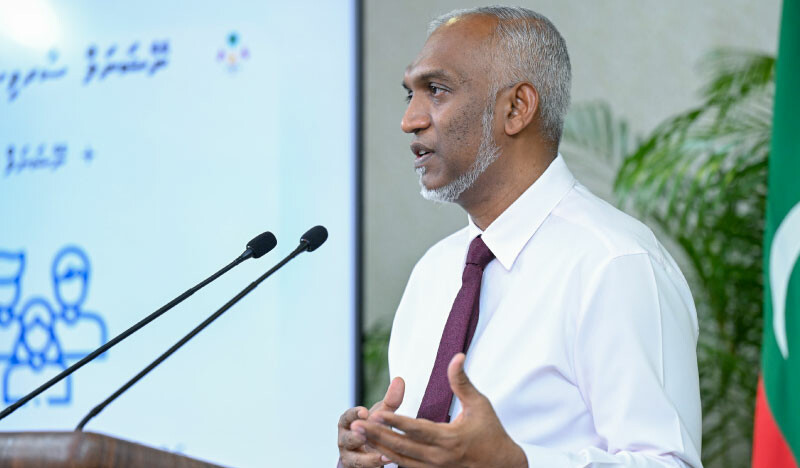
President Dr Mohamed Muizzu at the special press conference held yesterday to celebrate World Press Freedom Day, on May 3, 2025 | Photo: President’s Office
President Dr Mohamed Muizzu held a press conference yesterday in commemoration of World Press Freedom Day.
In the 14-hour-long press conference, he first gave the journalists updated information on the government’s endeavours and projects in the first two hours. After a short break for the afternoon prayer, he answered questions from the journalists regarding a variety of issues until approximately 12:50 a.m on Sunday, May 4.
advertisement

advertisement

advertisement
The last time the president held a press conference to answer journalists’ questions was in December 2023.
Our team will be covering the key takeaways from the press conference. Here are some highlights related to political influence on the judiciary, Indian military presence in the Maldives, legislative reforms, his decision regarding merging the Maldives Broadcasting Commission (Broadcom) and the Maldives Media Council (MMC), healthcare reforms, and the impacts of the Foreign Exchange Act.
Did Not Influence the Judiciary, Says Muizzu
One of the most frequently raised questions during yesterday’s extended press conference concerned political influence over the judiciary. When journalists asked whether he had exerted such influence, President Muizzu firmly denied the allegation.
“I am saying this the same as when I was sworn into office, I have not influenced the judiciary in any capacity,” the President said.
President Muizzu appointed Hussain Shaheedh to the Judiciary Service Commission (JSC) at a time when the Supreme Court was hearing a case concerning recent constitutional amendments. These amendments allow for the removal of parliamentarians who are expelled from, resign from, or switch the political party under which they were elected, during their term.
“Yes, that is just a coincidence. I did not know before something like this would happen, how would I know? That is not something I thought about like that,” Muizzu said regarding the timing of the JSC appointment.
Despite this, when a journalist later asked whether he was concerned about the apparent deadlock in the Supreme Court, President Muizzu said he was indeed concerned and had urged the President of the JSC on three separate occasions to resolve the issue promptly.
“It is because I am concerned, I have now mentioned on three occasions to the President of JSC, how it is going, and finish this issue as soon as possible,” Muizzu said.
He said they had assured him they would follow due process in handling this matter.
President Muizzu Refuses to Disclose Military Deal Details, Reaffirms Indian Troop Withdrawal
President Muizzu also declined to disclose the contents of military agreements signed with foreign nations, despite having previously campaigned on a strong promise of transparency on these issues and removing foreign military presence from the Maldives.
President Muizzu and his party, the People’s National Congress (PNC), ran a high-profile campaign, touting ‘Indian Military Out,’ accusing the former Maldivian Democratic Party (MDP) government of signing secretive military agreements with India that allegedly compromised national sovereignty. The Uthuru Thilafalhu (UTF) naval base development agreement with India was a central focus of this criticism.
However, yesterday, President Muizzu stated that the agreements could not be made public due to binding confidentiality clauses. He admitted that some clauses in the agreements had been “concerning and alarming” in terms of sovereignty, but said they have now been amended. He declined to share the details of those amendments or clarify how many agreements or clauses were involved.
When pressed by journalists, the president also refused to disclose the number of military agreements signed by the previous government. He said his administration is currently discussing with the relevant foreign parties to determine how much of the agreements can legally and diplomatically be disclosed to the public.
“We are engaged in talks to assess what can be revealed,” he said.
On the issue of foreign troop presence, President Muizzu firmly reiterated that all Indian military personnel previously stationed in the Maldives have now been withdrawn.
“There are no foreign soldiers in the country,” he stated. “The helicopters and Dornier aircraft are now operated by Indian civilians.”
He added that the government’s long-term goal is to phase out foreign civilian operators as well and establish a Maldivian-operated air service, which will include a paramedic helicopter to support national emergency medical response.
President Muizzu’s comments are likely to draw further scrutiny, given the contrast between his current position and the rhetoric used during his campaign—where he promised full transparency and accused the former government of compromising the country’s sovereignty through foreign military cooperation.
Gov’t Announces Plan to Cap State Budget Spending on Political Posts
President Muizzu announced plans to draft legislation to impose a cap on spending for political posts through the state budget yesterday as well. The ambitious legislative agenda he revealed for 2025 includes plans to submit 30 additional bills to Parliament this year.
Among the key proposals are constitutional amendments aimed at combining the presidential and parliamentary elections, introducing a one-round preferential voting system for the presidential election, returning the start of presidential terms to 11 November, capping the number of parliamentary seats at 93 regardless of population growth, and removing atoll councils.
A significant feature of the proposed changes is introducing a recall vote system, which would allow the public to remove elected officials, including parliamentarians and councillors, from office before the end of their terms. The president said this measure is intended to strengthen public accountability and empower citizens to hold officials accountable between elections.
Further legislative changes are planned to formalise limits on political spending. These include enshrining into law a cap on the number of political appointments funded by the state budget, giving Parliament the authority to set this limit, and requiring the government to disclose details of political appointments to Parliament. The president said the government aims to carry out political appointments within a framework of checks and balances.
During his 2023 presidential campaign, President Muizzu pledged to cap political appointments at 700. However, the opposition claims that the current number of political appointees exceeds 2,000, a figure that remains unconfirmed as the government has not publicly disclosed the exact count.
Despite journalists repeatedly asking for clarification regarding the number of political appointees, Muizzu continued to remain steadfast in not providing a clear answer. However, he did provide how much the state spends on political appointees.
“From the whole Maldivian workforce, the state workforce that is, they are around 49,000 people. For these 49,000 people, we spend around 997 million on salaries. Almost one billion a month to pay salaries. From this amount, around MVR 32 million is spent [per month] for people the government appointed, this is about three percent,” Muizzu revealed.
Maldives to Reduce Council Size on Small Islands, Increase Women’s Representation
Amongst the 30 bills he plans to introduce are amendments to the Decentralisation Act, aiming to downsize local councils on smaller islands and increase the women’s quota in councils.
The proposed amendments include introducing three-member councils for islands with populations under 2,000 and five-member councils for islands with populations above 2,000. Similar changes are planned for women’s development committees, with three-member committees for smaller islands and five-member committees for larger ones. Additionally, the president of each women’s development committee would be elected through a direct vote.
The government also intends to cap the number of city councillors at current levels and increase the women’s quota in councils from 33 percent to 40 percent.
President Muizzu noted that some islands have disproportionately large councils compared to their populations, pointing out that certain islands with around 20 residents and no schools still have five councillors.
Another amendment would empower the Ministry of Finance to ensure that councils spend block grants solely on fulfilling their legal responsibilities. President Muizzu highlighted concerns that some councils have been using these funds on foreign trips instead of addressing local needs, and he stressed the importance of financial discipline at the council level.
The president also reaffirmed his commitment to allocating a portion of the Tourism Goods and Services Tax (TGST) to local councils, a move intended to enhance their financial independence. He said that this policy would be implemented in November, although he did not disclose the specific percentage of TGST revenue to be allocated.
Muizzu Says No Decision Made to Merge Broadcom and Media Council
President Muizzu also said yesterday that he has decided not to merge the Maldives Broadcasting Commission (Broadcom) and the Maldives Media Council (MMC), despite previous statements from top officials and repeated proposals under multiple administrations.
Speaking on this topic, President Muizzu highlighted the importance of maintaining both institutions as independent and fair regulators. He said the government’s priority is to ensure that media content is factual and responsible, and that efforts to counter misinformation must not compromise the independence of media oversight bodies.
“What matters most is that these institutions function independently and fairly, and that the information shared with the public is accurate and truthful,” Muizzu said.
His remarks come after Attorney General Ahmed Usham earlier said he was working on a bill to merge the two independent agencies. Minister of Youth Empowerment, Information and Arts Ibrahim Waheed had also previously stated that the merger process was ongoing.
A bill proposing the merger was submitted to Parliament last year by Thulhaadhoo MP Abdul Hannan, a member of the ruling People’s National Congress (PNC). The bill faced intense criticism from media professionals and the public, with concerns raised over the potential impact on press freedom and independent regulation. It was later withdrawn.
Efforts to merge the two bodies have a long history. The idea was explored during former President Abdulla Yameen’s administration, and the previous Parliament formed a subcommittee to research the feasibility of such a move. The merger was also included in the current government’s legislative agenda.
Despite these developments, President Muizzu’s latest comments indicate a more measured stance, emphasising regulatory independence and accuracy in media over institutional consolidation.
Healthcare Reforms
During the press conference, Muizzu talked about the ways he wishes to reform the healthcare system of the country.
One of the key initiatives he aims to introduce is the establishment of General Practice clinics in Malé to ease the pressure on specialist clinics. He also plans to expand primary healthcare services across all atolls and set up tobacco cessation clinics in each one.
These efforts form part of his broader strategy to reduce tobacco use in the Maldives. Last month, the government submitted amendments to the Tobacco Act. The proposed changes include a Generation Ban, which would prohibit smoking for individuals born after 2007 and ban those under 21 from engaging in any tobacco-related activities, including the sale and distribution of tobacco.
USD 214 Million Converted Through Banks Since January, Says President
President Muizzu reported that USD 214 million has been exchanged through local banks since the enforcement of the Foreign Exchange Act in January 2025. The law, which mandates the conversion of foreign currency earnings, particularly from the tourism sector, through the formal banking system, has been credited with strengthening the country’s foreign reserves and contributing to a budget surplus.
At yesterday’s press conference, President Muizzu presented figures indicating that official reserves had remained above USD 700 million since the beginning of the year, reaching USD 791 million by the end of March. The increase is linked to the mandatory deposit and conversion of tourism sector earnings through domestic banks.
The Foreign Exchange Act, which came into force on 1 January, establishes a structured process for managing foreign currency inflows. It requires all non-exempt transactions to be conducted in Maldivian Rufiyaa and outlines regulations for the import, use, deposit, and exchange of foreign currency. Businesses conducting over USD 15 million in annual foreign currency transactions, including tourism establishments, are required to register with the Maldives Monetary Authority and channel their earnings through licensed banks.
According to the President, these changes are intended to increase oversight, reduce pressure on the informal dollar market, and ensure wider access to foreign currency for the general public. Planned benefits include increasing the current foreign currency travel allowance and easing transaction limits on bank-issued credit cards.
President Muizzu also outlined the broader fiscal situation. As of April 2025, government revenue stood at MVR 12.4 billion, while expenditure totalled MVR 10.5 billion. This resulted in a reported budget surplus of MVR 1.9 billion and a primary surplus of MVR 3.5 billion. The administration has also allocated MVR 2.5 billion to repay loans taken on by previous governments, including a recent payment of USD 100 million.
Looking ahead, the President reaffirmed his administration’s intention to reduce total debt to MVR 9 billion by year-end and to remain on schedule with foreign loan repayments.