

Land Act Reform Proposal on Deceased Heirs Rejected by Parliament
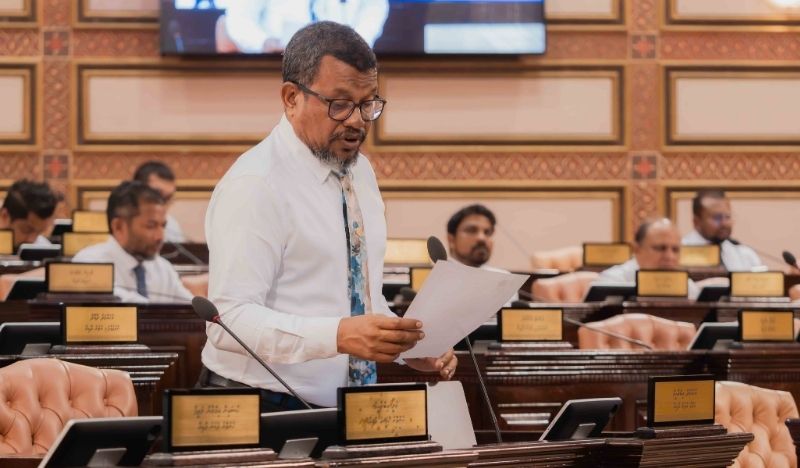
Galolhu North MP Mohamed Ibrahim (Kudu). | Photo: People’s Majlis
Parliament has rejected a proposed amendment to the Land Act that sought to address concerns over inheritance rights for children whose parents die before land distribution is finalised.
The amendment, submitted by Galolhu North MP Mohamed Ibrahim (Kudu), aimed to introduce provisions ensuring that the children of deceased heirs would be entitled to a share of land when an estate is divided. Under the current legal framework, such children are not explicitly recognised in the distribution process if their parent passes away before inheritance is settled.
The proposed changes would have required that, upon the death of a land title holder, immovable property be distributed not only among direct heirs but also extended to include the children of any deceased heirs. The amendment defined eligible children as those alive at the time of their parent’s death prior to the completion of inheritance distribution.
It also outlined criteria for determining whether a child already possesses land. According to the proposal, ownership through purchase, sale, division, will or inheritance would disqualify an individual from receiving additional land under these provisions. Land or flats obtained through government housing schemes would likewise be considered as ownership.
Presenting the amendment, MP Mohamed Ibrahim said the issue had been raised by numerous constituents and required legislative attention. He argued that the proposal would not conflict with Islamic inheritance principles, emphasising that it concerned state-owned land.
“We are not talking about private land, we are talking about Bandaara land,” he said during the parliamentary debate. “Bandaara land is state land, and the state has ownership over it. Therefore, the state should have the authority to establish rules governing its distribution.”
The Land Act currently does not include provisions addressing the rights of children whose parent—an heir—dies before inheritance is distributed. As a result, such individuals are excluded from receiving a share under existing rules.
During the debate, ruling party MPs opposed the amendment, claiming it was politically motivated. They alleged that the bill had been introduced despite the government already working on broader land legislation, suggesting it was intended to mislead the public.
The bill was rejected by 49 MPs of the ruling party, while 10 voted in favour of it.