

Maldives Committee Approves Media Regulation Bill Amid Protests
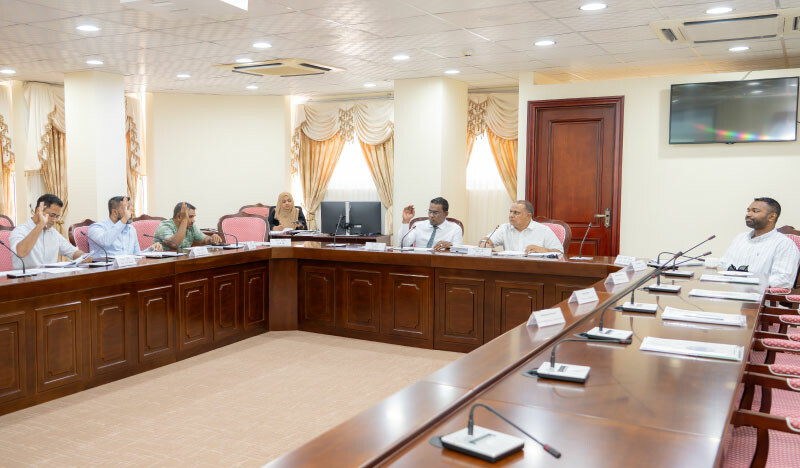
The Maldives Parliament’s Committee on Independent Institutions. | People’s majlis
The Maldives Parliament’s Committee on Independent Institutions has approved the Media Regulation Bill with 72 amendments, despite protests from journalists and warnings from civil society groups and international organisations that the legislation could curtail press freedom.
The bill, tabled on 18 August by Independent MP Abdul Hannan Aboobakuru, who is aligned with government MPs, seeks to dissolve the Maldives Media Council and the Broadcasting Commission of Maldives. In their place, it would establish a seven-member Maldives Media and Broadcasting Commission with wide-ranging powers, including the authority to impose fines, suspend outlets and block content.
Critics argue that the draft contains vague provisions on issues such as “public order” and “national security”, which they fear could be used to arbitrarily restrict reporting. Media groups and non-governmental organisations have warned that the bill, if passed without safeguards, risks eroding media independence.
Journalists have staged protests outside Parliament and the President’s Office, calling for the bill’s withdrawal rather than amendment. Tensions escalated on 10 September when reporters were forcibly removed from a closed-door committee session. Lawmakers defended the decision on the grounds of protecting personal details in public submissions, but the move drew criticism for undermining transparency.
Until today, review meetings on the bill had been held behind closed doors, but today’s session was open to the public. The Attorney General’s Office submitted comments on the legislation; however, most were left unaddressed in the final draft.
South Galolhu MP Meekail Ahmed Nasym, representing the opposition, proposed several changes to the bill, including renaming it the “Media Control Bill”. His proposals were rejected by the committee, which is dominated by members of the ruling People’s National Congress (PNC). Meekail also voiced concern that the committee had failed to consider a petition signed by 151 journalists and endorsed by the Parliament’s Petition Committee. The committee later decided that the concerns raised in the petition had already been addressed, after it had passed the bill.
Journalists present at the meeting argued that amendments introduced by Kelaa MP Abdulla Shareef not only failed to ease their concerns but worsened the situation. Key changes include altering the composition of the proposed media commission: the original bill allowed three members to be appointed by the President and four elected by media representatives. Shareef’s amendment instead gives Parliament the power to appoint three members, while splitting the four media-elected seats between broadcasting and other media sectors. Journalists fear this structure could allow state-owned outlets to dominate the voting process.
Another amendment raised fines for media outlets to MVR 250,000, a significant increase from the MVR 5,000–100,000 range in the original draft.
Although the committee chair called for a vote, the results were not immediately announced as protests continued inside the chamber. Journalists critical of the legislation have described it as a “Media Control Bill”, warning that it not only restricts press freedom but also extends regulation to social media platforms.
Amid its deliberations on the bill, the Committee on Independent Institutions also underwent a reshuffle of its membership. Baarashu MP Ibrahim Shujau, Dhidhdhoo MP Abdul Latheef Mohamed, and Funadhoo MP Mohamed Mamdhooh were newly appointed to the committee. Meanwhile, Thulusdhoo MP Ibrahim Naseem, Felidhoo MP Adam Zahir, and Mulaku MP Ibrahim Naufal were removed, without the changes being announced in a Parliament sitting — which is the usual procedure.
The Human Rights Commission of the Maldives, the Maldives Media Council, the Broadcasting Commission and several international organisations have all raised concerns about the legislation, warning it could undermine press freedom. Non-governmental organisations have gone further, describing it as a bill that would “destroy free press”.
Nevertheless, government-aligned lawmakers maintain that the legislation strengthens rather than restricts journalism, arguing that the concerns of media professionals have been taken into account.
A special sitting of Parliament has been scheduled for tomorrow to continue debate on the bill, according to local media reports. The committee’s work was completed while Parliament is in recess for the second term of the year, with the next term due to begin early next month.