

Maldives Steps Up Renewable Energy Drive to Cut Carbon Emissions, Says Minister
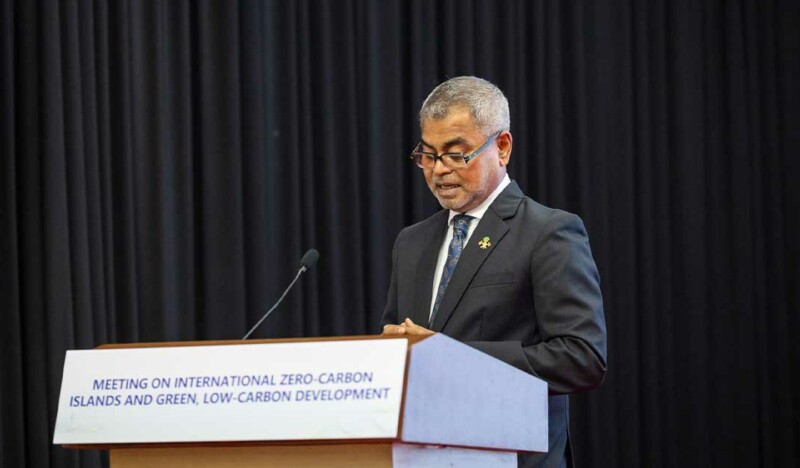
Minister Thoriq Ibrahim speaks at the International Zero Carbon Islands Conference | Photo: Ministry of Tourism and Environment
Minister of Tourism and Environment Thoriq Ibrahim has stated that the Maldives is intensifying its efforts to reduce carbon emissions through the nationwide expansion of renewable energy.
He made the remarks at the International Zero Carbon Islands and Green, Low-Carbon Development Conference held yesterday.
advertisement

advertisement

advertisement

Speaking at the conference, Minister Thoriq outlined the government’s aim to reduce carbon emissions to 1.52 million tonnes this year. He said the country’s current trajectory includes increased investment in solar energy systems and the identification of additional measures to limit harmful emissions.
The conference, jointly organised by China and the Maldives, is part of ongoing efforts to promote low-carbon development and knowledge exchange. As part of this cooperation, China has provided technical training opportunities and scholarships for Maldivians in renewable energy fields, covering tuition, accommodation, and travel costs.
Minister @thoriqibrahim attended the 'International Zero-Carbon Islands and Green Low-Carbon Development Exchange Conference' co-hosted by the Ministry and the Yantai Municipal People’s Government.
Speaking at the conference, Minister highlighted the Maldives’s commitments… pic.twitter.com/meXA1BI8Ss— Ministry of Tourism and Environment (@MoTmv) May 12, 2025
In January 2024, the installed renewable energy capacity in the Maldives stood at 53 Megawatts, accounting for only four percent of national energy consumption. According to the government, that figure has since increased by 15 Megawatts, with a broader goal to raise the share of renewables to 33 percent over the next five years.
The administration has also introduced multiple initiatives in waste management and other environmental sectors as part of a broader strategy to protect the Maldives’ fragile ecosystems.
While the recent increase in renewable capacity marks a shift in momentum, achieving the long-term goals will depend on continued investment, technical support, and the country’s ability to overcome infrastructure and resource challenges.