

Muizzu Calls for Abolition of Veto Power at UN Security Council
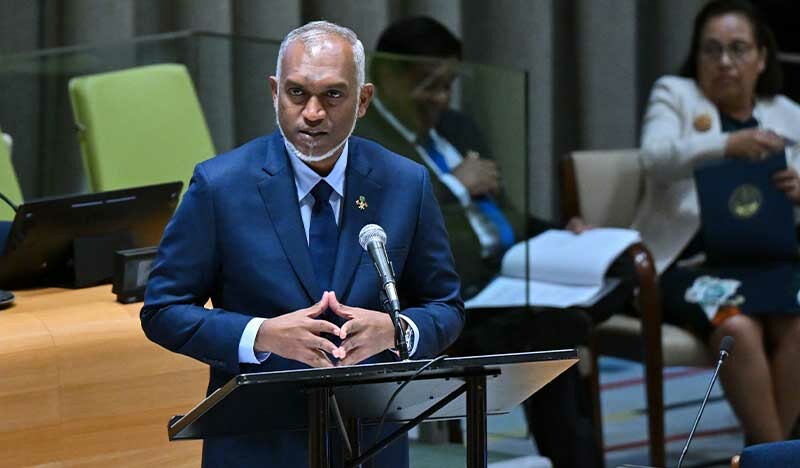
President Dr Mohamed Muizzu urges structural reforms to the Security Council, advocating for the elimination of veto power held by permanent members.
In his address to the United Nations Security Council, Muizzu called for major reforms to the Council’s structure, focusing on the abolition of the veto power. This marks the first time a Maldivian President has addressed the Council since the Maldives became a UN member 59 years ago.
advertisement

advertisement

advertisement
Muizzu stressed the Council’s responsibility in maintaining global peace and highlighted growing global mistrust in the system due to its perceived ineffectiveness. He attributed declining confidence to a lack of equal representation, transparency, and accountability.
Addressing ongoing conflicts, Muizzu condemned the Council’s inability to act decisively in situations such as the conflict in Palestine, citing the veto power as a key impediment. He called for a new intergovernmental process with text-based negotiations to drive forward meaningful reform, reiterating the Maldives’ call for a permanent rotating seat for Small Island Developing States (SIDS).
Muizzu concluded by urging the Council to remember its foundational principles and push for a world order based on justice and respect for international law.
“No Maldivian Will Abandon Their Homeland,” Says Muizzu
Muizzu affirms the Maldives’ commitment to safeguarding its islands at the High-Level Meeting on Sea Level Rise.
During the UN General Assembly’s 79th session, Muizzu delivered a strong message, asserting that no Maldivian would willingly leave their homeland despite the threat of rising sea levels. Addressing the High-Level Meeting on Sea Level Rise, Muizzu stressed the nation’s determination to protect its islands and ensure their survival.
He underscored the need to diversify economies and safeguard sustainable livelihoods tied to the ocean, while also highlighting the importance of preserving the Maldives’ cultural identity, heritage, and empowering local communities. Muizzu called for global collaboration to tackle the impacts of sea level rise, stressing that no nation should bear this burden alone.
Muizzu closed by calling for decisive action to secure the future of vulnerable island states, questioning the value of discussions if they do not lead to tangible outcomes.
Maldives Invites Investors to Explore Ocean Current and Renewable Energy Projects
President Dr Mohamed Muizzu announces Maldives’ focus on optimising ocean current energy and renewable energy investments, urging global investors to participate.
Speaking at a side event on renewable energy during the UN General Assembly, President Dr Mohamed Muizzu revealed the Maldives’ plans to optimise ocean current energy and explore novel renewable energy sources. He invited international investors to take advantage of these opportunities, noting the potential profitability of renewable energy in the Maldives.
Muizzu highlighted the country’s progress in increasing renewable energy capacity from 53 to 68 megawatts since COP28, outlining the Maldives’ commitment to achieving net-zero emissions by 2030. This includes expanding solar and wind energy projects and reducing reliance on fossil fuels.
He further detailed the Maldives’ renewable energy initiatives, including operationalising a waste-to-energy system in Addu City, developing a 13-megawatt system in Thilafushi, and implementing low-carbon transport systems. Muizzu emphasised the need for affordable climate finance and quick disbursement to meet these ambitious goals, aligning with the 1.5°C target.
Muizzu Calls for Urgent Global Action on Climate Change and Rising Sea Levels
Muizzu urges a coordinated global response to address the imminent threat of climate change and rising sea levels.
In his address at the High-Level Meeting on Sea Level Rise, Muizzu called for immediate global action to tackle the dual threats of climate change and rising sea levels. He proposed three key actions for the international community to take:
Increase Adaptation Finance: Muizzu emphasised the need to boost adaptation finance to balance efforts between mitigation and adaptation and simplify access to funds for vulnerable nations.
Operationalise the Loss and Damage Fund: He stressed the importance of fully implementing this fund to support countries like the Maldives facing severe climate-induced disasters.
Facilitate Technology Transfer: Muizzu urged advanced economies to assist SIDS and developing nations in enhancing climate action through favourable technology transfer agreements.
Muizzu highlighted the Maldives’ commitment to climate resilience but lamented the financial burden this places on the country’s budget, limiting resources for other developmental areas. He called for a stronger global partnership to address these challenges and ensure the survival of vulnerable coastal communities.