

Parliament Approved Media Regulation Bill Amid Protests
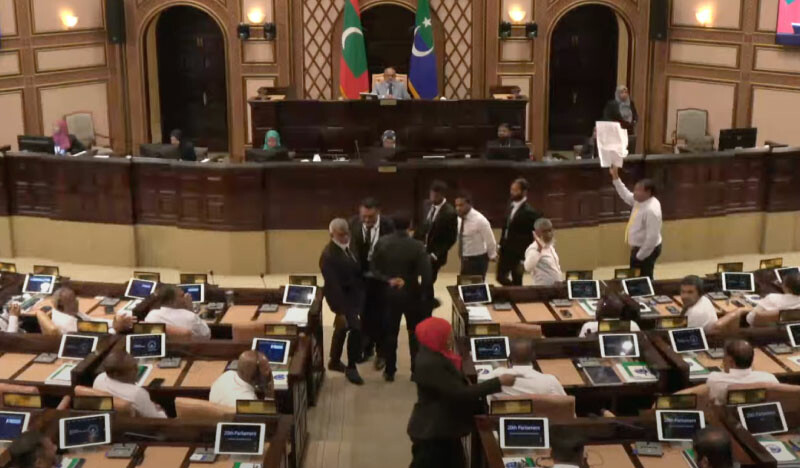
Opposition MPs are escorted out of the Parliament floor by security
The Maldives Parliament today approved the controversial Media Regulation Bill, passing it with 60 votes in favour and one against, amid strong protests both inside the chamber and outside the Majlis building.
Tensions Inside Parliament
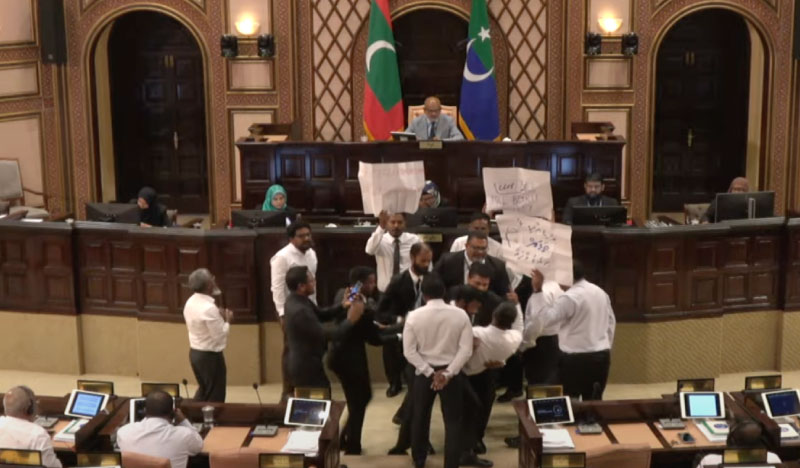
The sitting was marked by heated scenes as opposition MPs staged protests on the floor. Several members disrupted proceedings during the vote, prompting Deputy Speaker Ahmed Nazim to announce their names in accordance with parliamentary procedure. Under the rules, MPs who refuse to leave after being named are removed by force, and a number of opposition members were subsequently escorted out of the chamber.
Among those removed was South Galolhu MP Meekail Ahmed Nasym, who had proposed amendments to the bill but was escorted out before he could present them. Funadhoo MP Mohamed Mamdhooh, from the PNC, also submitted changes, including an amendment to the voting procedure for electing members from the media. The original draft granted each journalist a vote, but critics warned this could create an imbalance as state media, with its larger staff, would hold disproportionate influence. Mamdhooh’s revision limited voting to one per media outlet.
Scope of the Bill
The bill, introduced on 18 August by Independent MP Abdul Hannan Aboobakuru, who is aligned with government MPs, seeks to dissolve the Maldives Media Council and the Broadcasting Commission of Maldives. In their place, it would create a seven-member Maldives Media and Broadcasting Commission with wide-ranging powers to impose fines, suspend outlets, and block content.
The Committee on Independent Institutions approved the bill with 72 amendments, despite warnings from journalists, civil society organisations, and international bodies that it could curtail press freedom. Meekail Nasym, representing the opposition, sought to rename the legislation the “Media Control Bill”, but his proposals were rejected by the PNC-dominated committee. He also raised concern that a petition signed by 151 journalists and endorsed by the Parliament’s Petition Committee had been dismissed without proper consideration.
Concerns Over Amendments and Process
Journalists present at committee sessions said that amendments introduced by Kelaa MP Abdulla Shareef worsened the bill, particularly changes to the commission’s composition. The original draft allowed three members to be appointed by the President and four elected by media representatives. Shareef’s amendment gave Parliament the power to appoint three members while dividing the remaining four seats between broadcasting and other media sectors — a structure that journalists fear could allow state-backed outlets to dominate elections.
The committee itself underwent a reshuffle during deliberations. Baarashu MP Ibrahim Shujau, Dhidhdhoo MP Abdul Latheef Mohamed, and Funadhoo MP Mohamed Mamdhooh were added, while Thulusdhoo MP Ibrahim Naseem, Felidhoo MP Adam Zahir, and Mulaku MP Ibrahim Naufal were removed without the usual public announcement in Parliament.
The petition submitted by the Maldives Journalists Association and backed by media professionals nationwide was formally dismissed after PNC MP Mohamed Shameez of Madaveli argued that the concerns had already been addressed. His motion was carried with support from PNC members, while MDP MP Hussain Ziyad of Vaikaradhoo opposed.
Later, the Committee on Independent Institutions finalised its report. Committee chair Hussain Riza confirmed that the bill had been passed the previous day but required review by the parliament’s counsel general. Meekail Nasym called for time to study the counsel general’s observations, but amid his protests the ruling party majority voted to adopt the report.
Public and International Reaction
The bill has drawn significant criticism for containing broad and undefined provisions relating to “public order” and “national security”, which opponents warn could be used to suppress reporting. Another amendment raised fines for media outlets to MVR 250,000, up from the MVR 5,000–100,000 range in the original draft.
Journalists protested outside Parliament throughout the day, demanding the withdrawal rather than the amendment of the legislation. Tensions have escalated since 10 September, when reporters were forcibly removed from a closed-door committee session, a move defended by lawmakers as necessary to protect personal details in submissions but criticised as undermining transparency.
The Human Rights Commission of the Maldives, the Maldives Media Council, the Broadcasting Commission, and several international organisations have all raised concerns. Non-governmental organisations have described the bill as one that could “destroy free press”.
Government-aligned MPs, however, argue that the legislation will strengthen journalism by providing clearer regulatory mechanisms, insisting that the concerns of media professionals were taken into account during the review process.