

Parliament Confirms New Members to NIC and Advances Transparency Bills
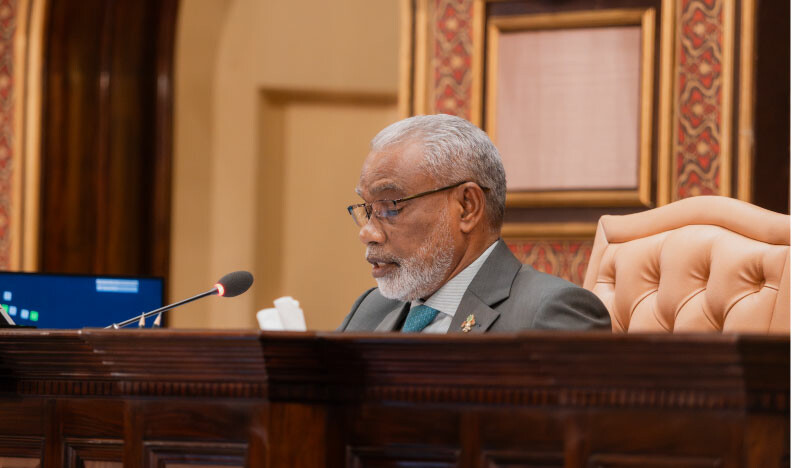
Parliament Speaker Abdul Raheem Abdulla. | Photo: People’s majlis
Parliament has endorsed four appointments to the National Integrity Commission (NIC), following the expiry of terms held by several outgoing commissioners. The newly approved members are Shifaz Ali, Fathimath Shareef, Ali Mohamed and Shuaib Abdul Rahman.
Of the four, Shuaib Abdul Rahman is the only returning member. First appointed on 26 October 2020, he has longstanding experience in the public sector, having served in various government roles. His background includes many years as a judge, over seven years as a director and five years as a member of the Judicial Service Commission. The NIC is made up of five members and is mandated to investigate matters involving the police, customs and other state agencies.
In the same sitting, MPs accepted two bills submitted by North Galolhu MP Mohamed Ibrahim (Kudu) of the opposition Maldivian Democratic Party (MDP). One seeks to amend the Audit Act to require independent institutions to disclose their financial statements. The other proposes changes to the Corporatization and Privatisation Act, obliging senior officials of state-owned companies to publicly release their financial disclosures.
Both bills received unanimous backing from the 50 members present, including those from the ruling People’s National Congress (PNC), and have been referred to parliamentary committees for further review. The bill concerning independent institutions has been sent to the Committee on Independent Institutions, while the proposal on state-owned enterprise executives has been forwarded to the Public Accounts Committee.
The proposals were introduced amid criticism over transparency and repeated calls from legislators for key office-holders to make their financial records public. During the debate, MPs also urged the publication of statements by senior government officials.
Under the amendments to the Audit Act, members of independent bodies and individuals in equivalent roles would be required to submit financial statements to the Auditor General within 30 days of assuming office, and again after one year in office. They would then have 90 days from the end of that one-year period to file. A penalty of MVR 5,000 is proposed for late submission.
The changes to the Corporatization and Privatisation Act would require the chairpersons, managing directors, chief operating officers and deputy managing directors of state-owned enterprises to submit their statements to the Auditor General for public access. The financial disclosures must be verified by an auditor licensed by the Institute of Chartered Accountants of the Maldives. A related constitutional amendment requiring ministers to publicly disclose their financial statements was approved by Parliament last week. Ministers in the previous MDP government had disclosed their statements, though the current administration has not followed this practice.
Parliament also voted to revise its regulations to tighten dress requirements for male MPs. While the General Committee initially reported that wearing a tie would not be compulsory, an amendment was approved mandating ties during sittings. The move follows protests by MDP MPs, who stopped wearing ties in response to ministers failing to answer their questions.
Disciplinary measures will be enforced for breaches of Article 71 of the Parliament Regulations, with penalties ranging up to suspension from both plenary sessions and committee meetings. Visitors to the People’s Majlis will also be required to comply with the updated dress code. Speaker Abdul Raheem Abdulla proposed clarifying the official dress rules following the protest.
In addition, Parliament passed a motion calling on the government to act on a special audit report concerning Fenaka Corporation.