

Parliament Introduces E-Petition Portal with Direct Floor Submission Feature
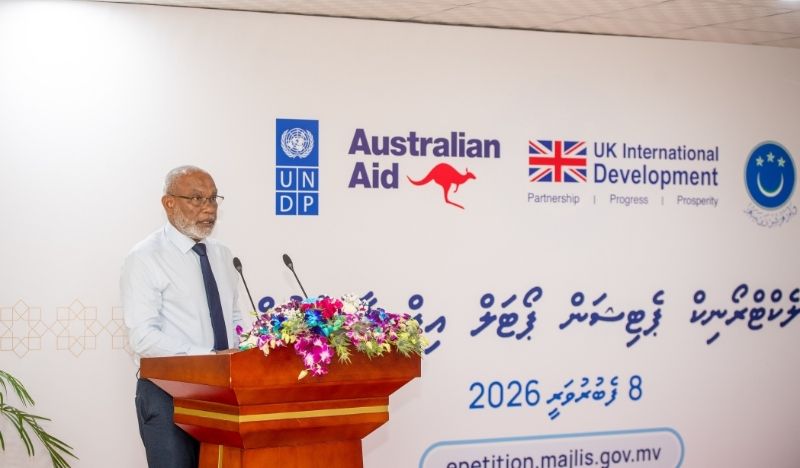
Speaker of the Parliament Abdul Raheem Abdulla speaking at the event to launch the e-petition platform on February 8, 2026 | Photo: Parliament
The Parliament launched the Maldives’ first-ever Electronic Petition System (E-Petition Portal) yesterday, introducing a feature that allows petitions to be sent directly to the parliament floor if they collect more than 2,100 signatures.
The portal enables citizens to submit and track petitions fully online, with signatures verified through the national digital identification system, eFaas. Petitioners can choose to proceed in multiple ways once a petition reaches 500 signatures, including seeking Member of Parliament sponsorship or collecting additional signatures to trigger legal action within the portal.
The system sets out two key thresholds. When a petition gathers 0.2 percent of the population—about 856 signatures—it is automatically designated a general petition, requiring Parliament to notify the relevant government agency within two working days. The agency must then review the petition and report its decision to Parliament within 21 days, inclusive of public holidays.
If a petition reaches 0.5 percent of the population, or around 2,100 signatures, it is elevated to a Special Petition. Such petitions are taken directly to the Parliament floor for debate and referred to the relevant government agencies, which are required to inform Parliament of their decision within 30 days, inclusive of public holidays.
The E-Petition Portal eliminates reliance on MP sponsorship, expands access for Maldivians living in remote islands, and introduces legally defined timelines for petition responses. The system ensures all processes—from submission to monitoring—are fully digital, secure, and traceable.
“The introduction of the e-petitions system marks a significant milestone in the digitalisation of democratic participation, serving as a vital bridge between citizens and the Parliament,” said Hon. Abdul Raheem Abdulla, Speaker of the People’s Majlis.
Developed in partnership with the United Nations Development Programme (UNDP) in the Maldives, and supported by the governments of the United Kingdom and Australia, the portal aligns the Maldives with international best practices in democratic governance. With the new system, the Maldives joins Pakistan and Thailand as the only countries in South and Southeast Asia with an electronic parliamentary petition system.
The initiative builds on a 2023 policy paper developed by UNDP and the People’s Majlis following nationwide consultations with women, youth, and civil society groups. The reforms aim to reduce administrative barriers, encourage participation from marginalised groups, and create pathways for petitions to be debated in the People’s Majlis.
Unlike the traditional analogue process, which relied on physical letters and often excluded non-affiliated citizens, the e-petition system provides a fully digital process accessible via smart devices. All petitions and documents on the portal are in Dhivehi, with accessibility features, such as voice-to-text, under development.
To submit a petition, a minimum of five signatures is required, after which the parliament conducts a compliance check. Approved petitions go live on the portal within 24–48 hours. While petitions can be viewed without eFaas login, signing and submission require authentication through the system. Additionally, under the new process, Parliament will accept both paper-based and electronic petitions within the updated thresholds framework. However, a single petition cannot be submitted in both formats, as hybrid submissions are not permitted to ensure accurate tracking of signatures.
According to the parliament, The launch of the Maldives’ first-ever e-petition system has been made possible with support from international partners, including the British High Commission and UK International Development from the UK Government, as well as the Government of Australia through the Department of Foreign Affairs and Trade (DFAT). Both partners have long supported initiatives to consolidate democratic institutions, promote inclusive governance, and strengthen parliamentary systems globally.