


Parliament Passes Referendum Bill
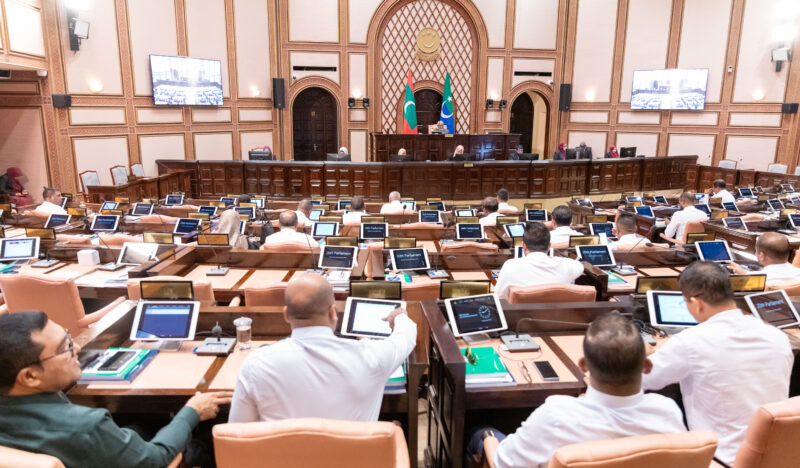
The Maldives Parliament has approved the Public Referendum Bill, paving the way for a formal legal framework to conduct national referendums on key public issues.
During Monday’s sitting, 64 members voted in favour of the bill while 12 opposed it. The legislation was tabled on behalf of the government by Inguraidhoo MP Ibrahim Falah and reviewed by the Committee on Independent Institutions. The committee had deliberated on the bill in closed-door sessions before opening its final meeting to the public yesterday.
Government Position
Falah, who also leads the People’s National Congress (PNC) parliamentary group, described the bill as a “milestone in citizen empowerment,” stating it delivers on President Dr Mohamed Muizzu’s pledge to expand public participation in governance.
He rejected opposition claims that the measure was intended to extend presidential terms, stressing that its sole purpose is to create a mechanism for gauging public opinion. Falah highlighted provisions that shift the presidential inauguration date from 17 November to 11 November to coincide with Republic Day, as well as measures to align presidential and parliamentary elections to cut costs and improve efficiency.
“The legislation ensures neither the Elections Commission, the parliament, nor the government can manipulate the ballot contrary to what is stated in Article 10,” he said.
Opposition Concerns
Opposition Maldivian Democratic Party (MDP) MPs criticised the bill, arguing that it leaves scope for abuse. South Galolhu MP Meekail Ahmed Nasym warned that the legislation contains “a hidden agenda” and accused the government of trying to manipulate electoral processes.
He raised concerns about short timeframes for the Elections Commission to organise referendums and about the body’s authority to draft information material, warning that such power could allow the government to frame issues in a misleading way.
South Hithadhoo MP Ibrahim Nazil, the minority leader, said that while his party was not opposed to referendums in principle, the committee had failed to address serious concerns raised by stakeholders.
Debate Highlights
The bill sparked sharp exchanges between ruling and opposition MPs. Falah argued that while the ruling coalition was prepared to shorten parliamentary terms by six months if elections were aligned, opposition MPs were reluctant to forgo salaries. Baarah MP Ibrahim Shujau suggested that the MDP opposed the bill because of fears of losing future elections.
Key Provisions
The bill operationalises Article 262 of the Constitution and sets out 39 articles regulating the roles of applicants, the Elections Commission and state institutions. Among the most significant clauses are:
- Moving the presidential inauguration date to 11 November
- Replacing the current two-round presidential election system with a new voting mechanism.
- Combining presidential and parliamentary elections.
- Allowing both the president and parliament to initiate referendums.
- Requiring referendums to be held within 45–90 days of submission, with results announced within 14 days.
All Maldivian citizens aged 18 and above will be eligible to vote in referendums through a secret ballot.