

President Addresses Ocean Governance and Climate Justice in Germany
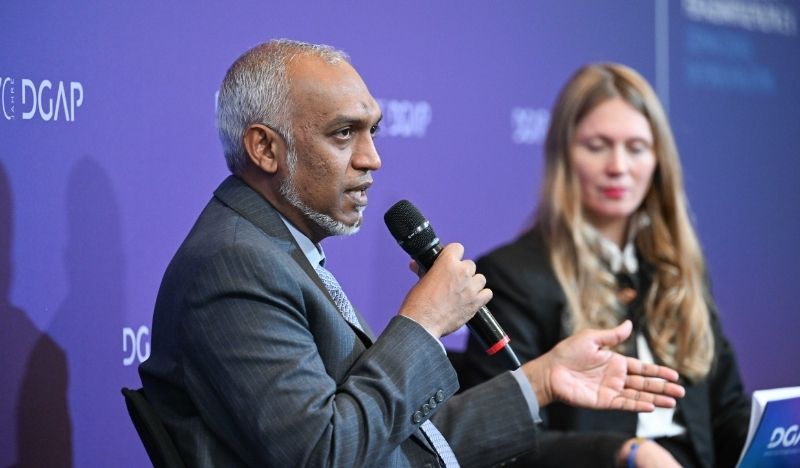
President Dr Mohamed Muizzu (R) speaking at the German Council on Foreign Relations on Wednesday, February 11, 2026 | Photo: President’s Office
President Dr Mohamed Muizzu visited the Council on Foreign Relations, Humboldt-Universität zu Berlin and the Embassy of the Maldives in Germany on the third day of his official visit to the country, undertaken at the invitation of President Frank-Walter Steinmeier.
According to the President’s Office and the German Council on Foreign Relations, President Dr Muizzu delivered keynote addresses focusing on ocean governance and climate responsibility, highlighting the Maldives’ perspective as a small island state highly vulnerable to climate change despite contributing minimally to global emissions.
advertisement

The visit, which began on Monday, 9 February, will conclude tomorrow, 13 February.
Address at the German Council on Foreign Relations
President Dr Muizzu visited the Deutsche Gesellschaft für Auswärtige Politik (DGAP), where he was received by Vice-President Rolf Nikel, Director Thomas Kleine-Brockhoff and Dr Kira Vinke, Deputy Research Director and Head of the Centre for Climate and Foreign Policy.
In his keynote address, the President spoke on the role of the ocean in foreign policy, outlining the Maldives’ position on coordinated ocean governance. He said the ocean remains underrepresented in strategic and diplomatic discussions despite its importance for climate regulation, biodiversity and global food security.
Emphasising that the Maldives’ history, economy, culture, and security are closely tied to the ocean, he outlined the impacts of climate change on the country’s economy and way of life. He noted that the Maldives lies at the crossroads of major trade routes and increasing strategic competition, describing the Indian Ocean as one of the most consequential regions of the 21st century.
The President also stressed the need to safeguard undersea digital infrastructure, which carries the majority of global data traffic, through international cooperation and shared norms. He said small states are increasingly acting as norm-shapers by advocating stronger climate action, marine protection and inclusive multilateralism.
During a question-and-answer session, he outlined efforts to strengthen the Maldives’ capacity to protect its Exclusive Economic Zone and reaffirmed the country’s commitment to global climate action. Reflecting on 60 years of diplomatic relations, he noted potential to expand cooperation with Germany, including in shore protection.
Visit to the Maldives Embassy in Berlin
President Dr Muizzu also visited the Embassy of the Maldives in Berlin, where he was welcomed by Ambassador Shaan Shakir and embassy staff. Accompanied by members of his delegation, the President signed the guestbook and met staff to discuss their work and experiences in Germany.
Keynote at Humboldt-Universität zu Berlin
Later, President Dr Muizzu visited Humboldt-Universität zu Berlin, where he was received by Dr Yoan Vilain, Vice-Provost for International and European Affairs, and Professor Dr Marcel Robischon, Head of the Division of Agricultural Ecology.
In his keynote speech, the President called for a fair and collective global response to climate change that aligns responsibility with support. He noted that countries such as the Maldives contribute negligible greenhouse gas emissions yet face some of the most severe impacts.
He said adaptation is a matter of survival for the Maldives and essential to safeguarding its nationhood, culture and identity. The President highlighted the need to integrate climate risk into national planning and budgeting, scale up adaptation finance, and strengthen community-led initiatives through enhanced local governance.
Describing adaptation financing as an issue of climate justice, he emphasised the importance of predictable and concessional funding for vulnerable countries. He also pointed to the role of natural ecosystems such as reefs and mangroves as cost-effective climate defences, and stressed that adaptation and development must progress together.
During the subsequent discussion, the President underlined the role of academic institutions in countering misinformation and bridging science and policymaking. He encouraged greater collaboration among Small Island Developing States and called for increased mitigation and adaptation support from major emitters.
The official visit continues as the Maldives and Germany mark six decades of diplomatic relations.