


President Defends Gov’t Over Dollar Shortage and Card Limits
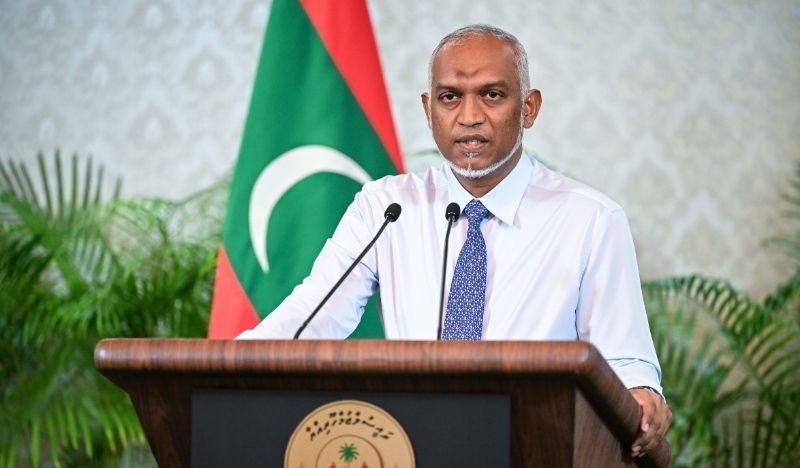
President Dr Mohamed Muizzu speaking at the President’s Office, on May 11, 2026 | Photo: President’s Office
President Dr Mohamed Muizzu has defended the government’s handling of the dollar shortage and limits on overseas card transactions, arguing that the pressure reflects a rise in online business activity rather than a failure of economic policy.
Responding to a question on whether dollar scarcity and Bank of Maldives’ foreign transaction limits indicated a failure of the administration’s economic policies, President Muizzu rejected that characterisation.
advertisement

“It is not a failure. Rather than failing, it has been a massive success. The reason I say this is because there has never been an era where online business has flourished to this extent,” President Dr Mohamed Muizzu said.
The President’s statement frames the pressure on foreign currency as a sign of increased digital commerce. However, recent developments at Bank of Maldives and figures from the Maldives Monetary Authority point to a more complicated reality. The country’s dollar constraints are not limited to consumer demand for online services or overseas purchases. They are also tied to sovereign debt repayments, high import dependence, and the need to ration limited foreign currency across households, students, businesses and essential public needs.
BML has announced a series of changes to its foreign currency processes, including new controls on overseas card use, e-commerce transactions, student cards, credit card fees and telegraphic transfers. The bank said the measures are intended to distribute the foreign currency it obtains more fairly among customers at a time when demand for dollars remains high.
One of the most significant changes concerns overseas card use. Through a digital partnership with Maldives Immigration, BML will be able to enable foreign spend limits specifically for card-present point-of-sale transactions conducted overseas. The bank said this would allow customers travelling abroad to continue using their cards for genuine transactions, while introducing safeguards against unauthorised or abusive practices.
The bank is also introducing changes for students abroad. Students who do not have their own cards and currently rely on a guardian’s card will be issued a student card with the applicable student foreign spend limit. Until the new card is issued, the guardian’s card may be used for three months.
BML has also pointed to the use of personal foreign spend limits for business-related online purchases. According to the bank, some individuals have been using personal cards to carry out business transactions on selected online shopping platforms, resulting in large amounts of dollars being sold to a limited number of parties. To address this, BML will set a daily budget for foreign currency sold through such online transactions, while keeping sites used for other legitimate personal purposes unchanged at this stage.
The bank will also introduce a monthly limit of 30 e-commerce transactions per customer. BML said fewer than three percent of customers currently exceed that level, and that these customers are among those using selected online shopping sites for business purposes. Cards linked to dollar accounts will continue to be usable without foreign spend restrictions, subject to the dollars available in the account.
For customers with multiple credit cards, BML said annual fees will only be charged for one card, since the monthly foreign spend limit is applied per customer rather than per card. The bank also said the sale of USD or other foreign currency support for telegraphic transfers will be processed only during bank operating hours, although US dollar TT transfers can continue to be processed 24 hours a day, including on holidays. Attempts to obtain larger amounts of dollars by splitting TT transactions will also be monitored and restricted within imposed limits.
These measures show that the foreign currency issue has moved beyond a simple question of online business growth. The system is being actively managed to prioritise who receives access to limited dollars, for what purpose, and under what conditions.
The pressure is also visible in the MMA’s April balance sheet. Total foreign currency financial assets fell from MVR 22.13 billion at the end of March 2026 to MVR 12.90 billion at the end of April, a decline of around MVR 9.22 billion in a single month. The fall was concentrated mainly in cash balances and securities.
Cash and balances with banks declined from MVR 17.07 billion to MVR 9.16 billion, while investments in securities fell from MVR 4.31 billion to MVR 2.87 billion. On the liabilities side, foreign currency balances held by the Government and Government institutions fell from MVR 5.79 billion to MVR 576.6 million, a decline of about 90 percent.
The timing strongly points to the settlement of the Maldives’ USD 500 million sovereign Sukuk as the main driver of the drawdown. The Government settled the Sukuk on 2 April 2026, including USD 500 million in principal and USD 24.68 million in profit payments. Public statements at the time said the repayment was made using the Sovereign Development Fund and official reserves.
The total repayment of USD 524.68 million is equivalent to roughly MVR 8.1 billion, broadly consistent with the scale of the movement recorded in the MMA’s April balance sheet. The figures do not provide a full cash-flow breakdown, but the size and timing of the decline suggest that the Sukuk repayment was the central reason for the sudden contraction in visible foreign currency buffers.
The repayment helped the Maldives avoid a major sovereign default risk, but it also reduced the foreign currency resources available within the system. In that sense, the April figures capture both sides of the same policy outcome: the country met a major external obligation, but the act of doing so narrowed the space available for other dollar needs.
This is the gap between the President’s political defence and the financial reality shown by the banking system. Online business may have increased, but BML’s new measures indicate that the dollar shortage is serious enough to require tighter controls over card use, online transactions and foreign transfers. The issue is not merely that more Maldivians are spending online. It is that households, students, importers, businesses, public institutions and debt repayments are all competing for the same limited pool of foreign currency.
The pressure also comes as the Government pursues major development plans, including airport expansion, reclamation, logistics projects and Special Economic Zones. While such projects may be announced in domestic terms, their execution depends heavily on access to dollars for imported machinery, fuel, construction materials, equipment, consultants and foreign contractors.
The Government’s ability to rebuild foreign currency buffers will now be central to how the current situation is judged. If tourism receipts, external financing, stricter foreign exchange enforcement or new investment inflows restore dollar liquidity, the April drawdown may be seen as a managed repayment cycle. If buffers remain thin, the country could face a more difficult period in which debt servicing, public investment, imports and private sector demand compete more sharply for dollars.
The deeper issue is therefore not whether online business has flourished, but whether the Maldives has enough foreign currency to support that growth while also meeting debt obligations and financing the Government’s wider development agenda. BML’s latest measures and the MMA’s April figures suggest that the pressure is structural, not just behavioural.