

President Muizzu Highlights Role of Opportunity in Corruption Across All Job Levels
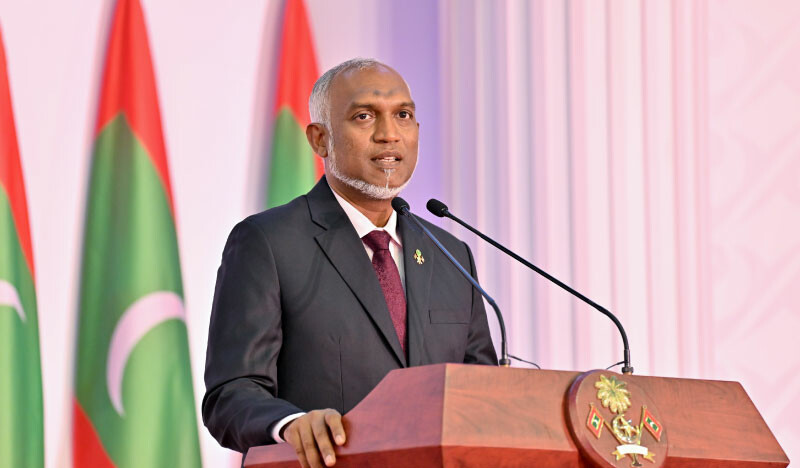
President Dr Mohamed Muizzu speaking at the Republic Day ceremony on November 11, 2025 | Photo: President’s Office
President Dr Mohamed Muizzu said that those most likely to engage in corruption are typically individuals with easy access or opportunity, often occupying low- and middle-level positions, though instances also occur among higher-ranking officials.
“Most of the time, corruption can be carried out, and is being carried out, by those who have the opportunity to do so. From the lowest level of the job to the middle level is where it happens the most. Corruption also happens at the top,” he said.
Speaking at the Republic Day ceremony yesterday, the President highlighted that his administration remains committed to maintaining a corruption-free government, fulfilling the mandate given by citizens two years ago. He stressed that eliminating corruption requires significant reforms, including transparency and robust measures to prevent misconduct, and noted that such challenges are not unique to the Maldives.
As part of improving governance, President Muizzu highlighted the Digitalisation Maldives 2.0 initiative. He said the government has begun automating services, including immigration, to remove opportunities for corruption in processes such as work permit renewals and visa issuance.
Referring to immigration services digitalised on Monday, he noted that all processes are now automated and recorded, eliminating the possibility of in-person requests or informal interventions, and promoting transparency and accountability.
The President added that digitalisation will expand across state institutions, including the judiciary and banks, and stressed the upcoming ID card digitalisation project. He acknowledged that the rollout may face some resistance but emphasised the importance of collective effort, particularly from the youth, to ensure elderly citizens can also access and benefit from the service.
President Muizzu concluded that reducing corruption requires both institutional reform and citizen cooperation to ensure accountability at all levels.