

President Ratifies 16th Amendment to Decentralisation Act Amid Council Opposition
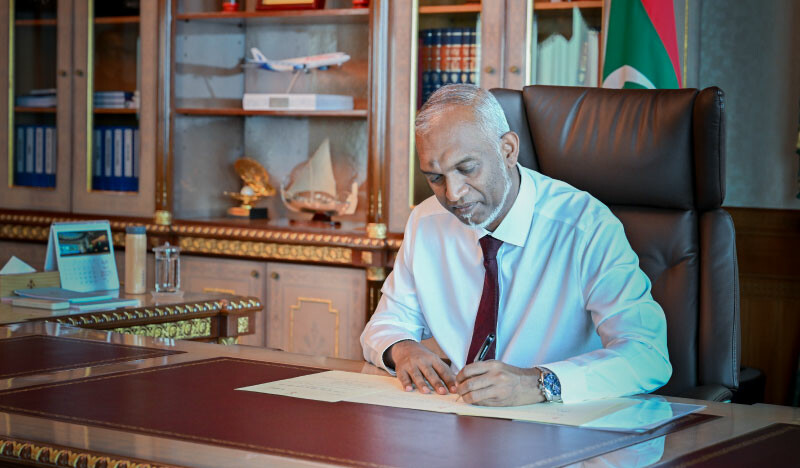
Photo: President’s Office
President Dr Mohamed Muizzu ratified the 16th Amendment to the Decentralisation Act on Thursday, despite local councils across the country calling for it not to be enforced.
The move enacts a series of reforms that redefine the financial and administrative powers granted to local councils.
advertisement

advertisement

advertisement

Under the amendment, Local Authority Companies are now limited to undertaking essential rural infrastructure projects exceeding MVR 10 million. Any business activities by these companies that compete directly with private enterprises must be wound down within 90 days. The legislation also prohibits councils from charging rent for land or buildings used for basic public services—a measure critics warn could reduce crucial revenue streams for local governments.
Councils must now follow stricter financial procedures, including maintaining bank accounts under Ministry of Finance guidelines and providing statements when requested. They can no longer receive revenue directly without first settling arrears owed for public services.
The amendment also places restrictions on councils approaching the end of their term. In the final year before elections, councils cannot recruit new staff, lease land, lagoons, or reefs, or initiate new development projects outside existing development plans without approval under regulations issued by the Ministry of Finance and the Local Government Authority (LGA).
During a recent visit to Baa Atoll, President Muizzu criticised local councils for misusing allocated funds on what he described as “experience trips” abroad, which he categorises as “wasteful,” instead of using them for municipal services. Councils in Baa Atoll, however, pushed back. The President of Kihaadhoo Council, Hussain Shaafiu, defended such trips, saying they provide opportunities to observe service delivery practices—including waste management and public engagement—from other domestic and international communities. He noted that over the past four years, several councils had visited Kihaadhoo to study local waste management systems.
The amendment has drawn criticism from councils who argue that the reforms weaken financial autonomy and concentrate decision-making powers in Malé. Leaders warn that limiting their ability to generate revenue and oversee local development could undermine the purpose of decentralisation itself.
The government maintains that the changes strengthen accountability, prevent politically motivated spending ahead of elections, and ensure that local authority companies do not crowd out small private businesses in rural areas.
The 16th Amendment adds a new chapter to the ongoing debate over decentralisation in the Maldives, highlighting the tension between expanding local empowerment and enforcing tighter financial oversight.