

President Solih Weighs in on System Change Vote
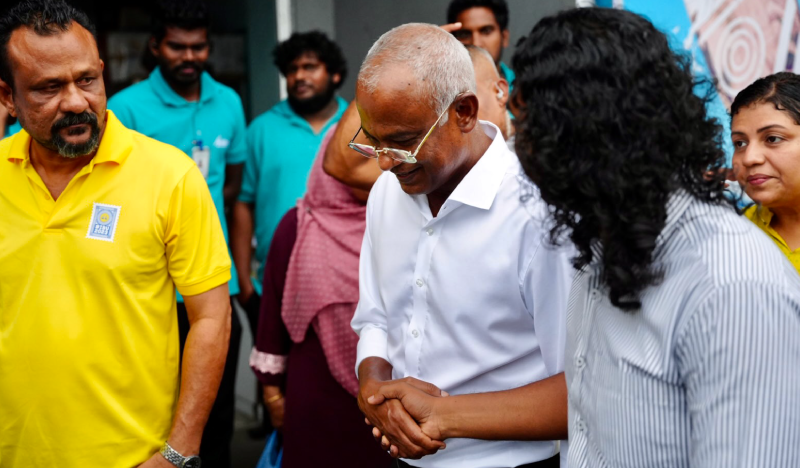
Photo: MDP
President Ibrahim Mohamed Solih has stated that if Parliament secures a three-fourths majority in favour of changing the system, he will request the Election Commission (ECM) to conduct the vote before the second round of the presidential election, during a door-to-door campaign yesterday.
The President acknowledged the feasibility of conducting the systematic vote after the presidential election but emphasised that it would be a challenging if attempted before the second round.
He noted that discussions have arisen regarding scheduling the vote for October 30, with the Election Commission suggesting a minimum preparation period of 30 days.
President Solih clarified, “If Parliament decides to hold the vote within a specific timeframe following the presidential election, I can approach the Election Commission to conduct it before the second round of voting.”
The resolution for a referendum on a parliamentary system, initiated by Democrat Ilyas Labeeb, proposes an official vote in October. The resolution gained approval in Parliament yesterday, garnering support from members of the Maldivian Democratic Party (MDP).
However, there are concerns that the MDP may withdraw its support for the change if President Solih wins the second round of elections. When questioned about his stance on the system change, the President refrained from expressing a position until an official decision is reached.
In contrast to the current presidential system, a parliamentary system involves the election of a prime minister by the parliament, with the President holding a symbolic role as the head of state.
Consequently, if the government system undergoes a popular vote-induced alteration, the President’s powers and responsibilities would substantially diminish, even if he secures a second term.
Responding to inquiries from journalists, President Solih asserted that if a three-fourths majority in Parliament endorses the system change, he is constitutionally obligated to submit it to the people for a systematic vote. He affirmed his commitment to following this process and gauging public sentiment before making further decisions.
President Solih pointed out that countries, including France and Sri Lanka, have distinct divisions of powers between the President and the Prime Minister, with separated internal and external responsibilities.