

Spending More, Building Less: An Exploration of Government Spending
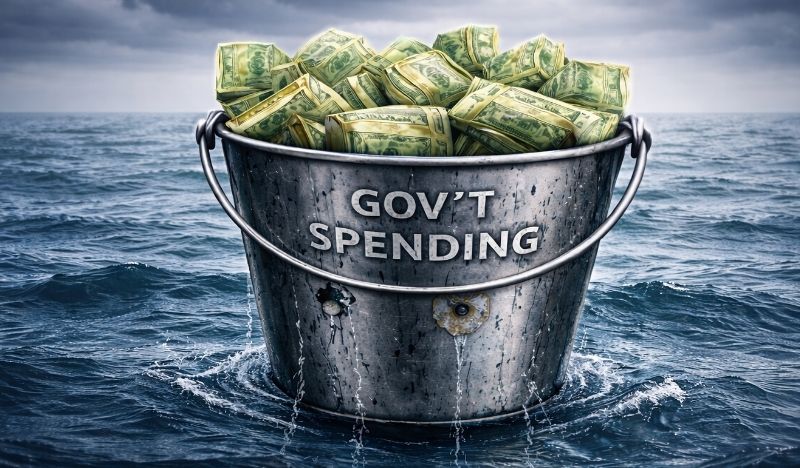
Photo: AI generated image
As the world grapples with a global economic crisis triggered by the Middle East war, which could drag on for an indefinite amount of time, governments across the world are forced to reassess spending priorities. For the Maldives, which relies on tourism and imports, these pressures hit at the most inopportune time, when government spending is already soaring high.
In the past decade alone, the Maldives government’s spending has more than doubled. In 2015, government spending stood at MVR 21.3 billion. Fast forward to 2025; expenditure rose to MVR 49.2 billion, up by approximately 131% in ten years.
The deficit each year gives a clearer picture of the country’s economic health.
Maldives Monetary Authority (MMA) figures from last year show that the government’s deficit stood at MVR 8.84 billion, optimistically an improvement of 35% from the deficit compared to the year 2024, when the deficit stood at MVR 13.6 billion.
This piece explores government spending habits over the last decade or so.
Spending surged after COVID-19 (understandably), but it never came back down
According to MMA documents, the largest deficit, regime-wise, was seen during President Ibrahim Mohamed Solih’s presidency. His administration, from 2019 to 2023, made a total revenue of MVR 121.3 billion, while his expenditure stood at MVR 177.80 billion, making up a deficit of MVR 56.60 billion. His administration also took on the most debt, bringing the total state debt to MVR 126 billion when he left office.
Many attribute the economic crisis at that time to the global pandemic COVID-19. Tourist arrivals were halted for several months, layoffs became common, and the health sector was overwhelmed.
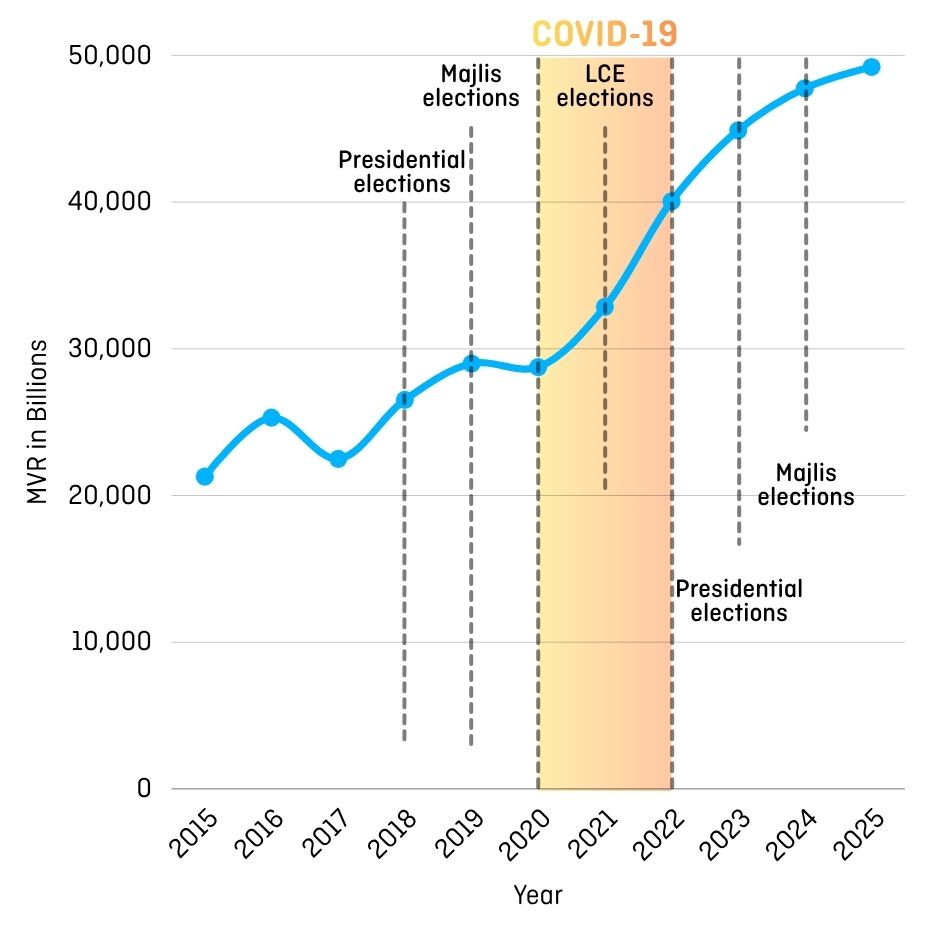
After the COVID years (from 2020 to 2022), government spending continued to rise. By the end of 2023, which coincided with the presidential election, the government had spent MVR 44.9 billion. And when President Mohamed Muizzu took office, by the end of 2024, his administration had spent MVR 47.8 billion and MVR 49.2 billion in 2025.
In addition to the global pandemic, Solih’s administration had to navigate through the impacts of the Russia-Ukraine war.
Where does the money go?
Government spending is not inherently bad. However, where and how that spending is structured matters.
Most of the spending goes towards running the government, not development.
A breakdown of 2025 expenditure data from the Ministry of Finance shows that approximately MVR 37.4 billion (85 percent) was spent on recurrent expenditure, compared to only around MVR 6.8 billion (15 percent) in capital spending. This means that 85 per cent, or 5 in every 6 rufiyaa, go toward maintaining the state; salaries, administrative costs, subsidies, and debt servicing. While only 1 in every 6 rufiyaa is spent on infrastructure and development projects.
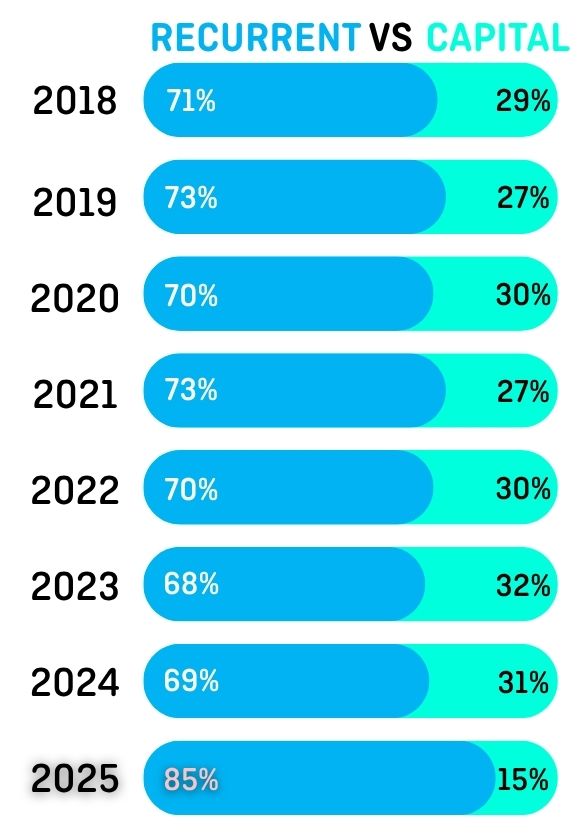
Last year was extraordinarily fiscally conservative in capital spending compared to previous years, where only MVR 6.81 billion was spent on capital, compared to 2024 when the government spent MVR 13.3 billion, more than double its amount.
In fact, recurrent expenditure has doubled throughout the years (and consistently never stopped growing), rising from MVR 17.9 billion in 2018 to MVR 37.4 billion in 2025, while capital spending has fluctuated.
If we look at ratios, Recurrent vs Capital spending stood at 70/30 eight years ago, but now it is 85/15. This is a major shift in spending priorities. The government has shifted away from development and poured more into maintaining the state.
Halting development projects to trim the spending budget instead of reducing administration costs makes no fiscal sense. Short civil service work hours and excessive public holidays have bred an inefficient system within the government. And the countless political appointees, deputy ministers, state ministers, and director-level positions at SOEs given to political activists with no merit only add to the burden. And only the citizens bear the real cost of these decisions.
The core problem: governments have historically spent more than they earn
One fact that rings true for all elected administrations in the Maldives is that they spend more than they earn. The deficit numbers, that is, spending minus earnings, are interesting precisely because they show how much the country falls every year, every administration, into the depths of economic ruin.
Under President Mohamed Muizzu’s administration, until the end of last year, the total deficit was over MVR 23.01 billion. President Ibrahim Mohamed Solih racked up a deficit of over MVR 56.50 billion at the end of his term. The total deficit of President Abdulla Yameen’s administration was over MVR 18.80 billion; President Mohamed Waheed racked up a total deficit of MVR 4.6 billion, while President Mohamed Nasheed’s deficit was over MVR 12.6 billion. President Maumoon Abdul Gayoom’s total deficit (his last five years) stood at MVR 5.5 billion.
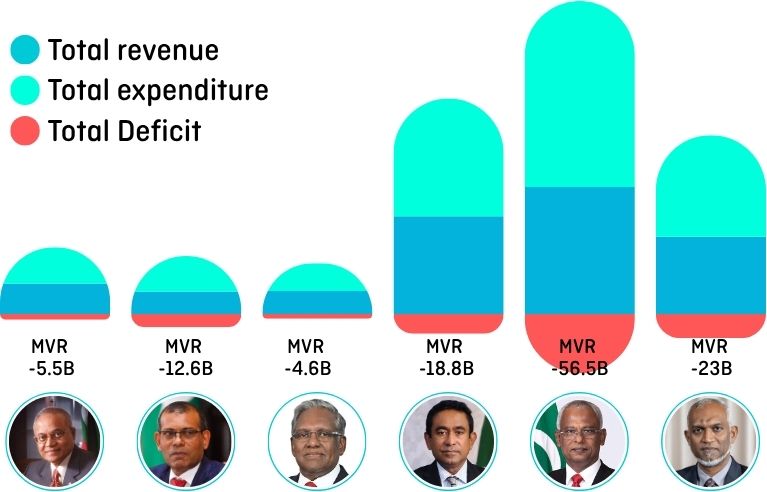
Year after year, the gap created by governments spending beyond their means has resulted in persistent fiscal deficits. Over the elected administrations, this pattern of incurring deficits has been consistent. While the scale varied, no government has operated without a deficit. It’s not just them, it’s all of them.
If deficits persist across the regimes, is the issue a lack of revenue, or something more fundamental in how public funds are managed?
The Maldivian government is not poor. We are, in fact, among the richest in our region. The Maldives has the highest GDP per capita in South Asia, with approximately USD 12,000–13,000 per person, according to the World Bank.
The government heavily taxes our golden egg-laying tourism industry in every way they can, from airport development fees and TGST to the Green tax. Tourism consistently leads in monthly revenue collection without fail.
But the government is always bleeding money.
Raising taxes and boosting revenue will go so far unless spending habits are fixed. If the bucket is leaking, pouring more water into it will never be enough.