

Maldives Condemns Attacks by Iran, Israel and US, Urges Immediate Ceasefire
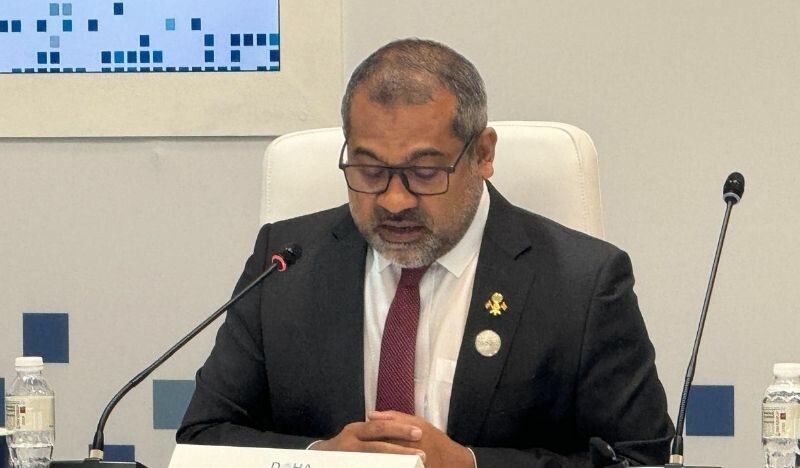
Minister of Foreign Affairs, Dr Abdulla Khaleel, at the Doha Forum 2025 on December 6, 2025 | Photo: Ministry of Foreign Affairs
The government of Maldives has condemned a series of attacks involving Iran, Israel and the United States, warning that the escalating violence is heightening tensions across the Gulf region.
In a statement issued yesterday, the Ministry of Foreign Affairs said the Maldives strongly condemns attacks by the United States and Israel against Iran, as well as by Iran against several Gulf states, including Saudi Arabia, United Arab Emirates, Qatar, Kuwait and Bahrain.
advertisement

The government expressed particular concern over incidents affecting civilian locations such as airports and oil facilities in the Gulf, describing them as clear violations of international law and the Geneva Conventions. It also said the attacks were carried out despite the Gulf states not engaging in retaliatory actions.
Statement by the Government of Maldives condemning attacks by Israel and US against Iran and the attacks by Iran against states in the Gulf region
🔗 | https://t.co/GPutw0Pb6K pic.twitter.com/JmGWWUnA2c— Ministry of Foreign Affairs 🇲🇻 (@MoFAmv) March 10, 2026
The Maldives also voiced deep concern over the broader escalation in the Middle East following military strikes initiated by Israel and the United States against Iran. The government condemned the attacks, including strikes on civilian targets such as a girls’ school that reportedly resulted in more than 100 civilian casualties, as well as damage to hospitals and oil facilities. Several international media reports indicate that the US is responsible for the attack on the girls’ school, although the US government claims that the missile which hit the school was fired by Iran itself.
According to the statement, the developments have further heightened tensions in the Gulf region and threaten prospects for peace.
The Maldives called for an immediate ceasefire by all parties and urged the international community to intensify diplomatic efforts to restore peace, stability and security in the region.
The United States and Israel launched direct strikes on Iran on 28 February, targeting military, missile and nuclear infrastructure, as well as senior leadership. The Supreme Leader of Iran, Ali Khamenei, was killed in attacks. International media have reported that his son, Mojtaba Khamenei, has been selected to succeed him as Supreme Leader.
Iran later retaliated by launching strikes on US bases in several Gulf states, including Dubai, Qatar, the United Arab Emirates and Bahrain. Tehran has also restricted passage through the Strait of Hormuz, a key global shipping route through which about 3,000 crude oil tankers pass each month, carrying an estimated 20 million barrels of oil per day, according to the International Energy Agency. Iranian authorities have said only vessels from countries that have diplomatically distanced themselves from the United States and Israel will be allowed to transit the strait.