

Parliament Rejects Bill on Atoll Councils and MDP Resolution on PSM Bias
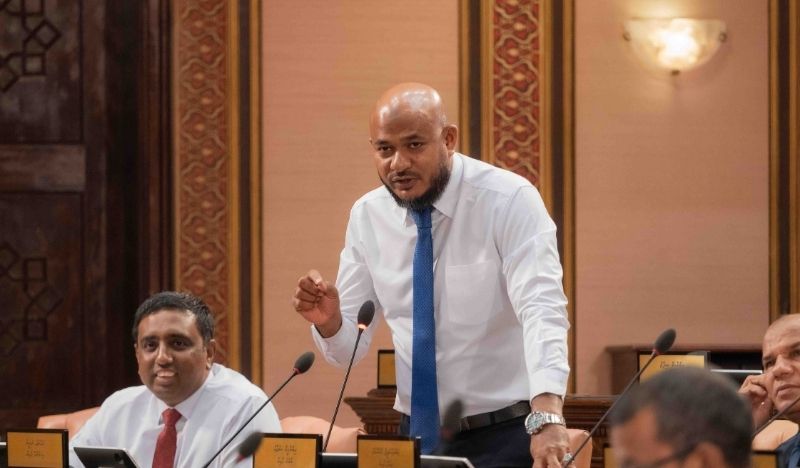
MP for Baarah constituency Ibrahim Shujau speaking in parliament on May 4, 2026 | Photo: Parliament
Parliament has rejected a bill seeking to reverse the abolition of atoll councils and reinstate them under the previous decentralisation framework, as well as a resolution seeking MPs’ views on allegations that Public Service Media (PSM) has shown political bias, restricted the Maldivian Democratic Party’s (MDP) access to public communication, and failed to uphold legally guaranteed editorial independence.
In addition to debates and votes on these two matters, today’s parliamentary agenda also included questioning Minister of Infrastructure, Housing, and Urban Development Dr Abdulla Muththalib and deliberations on removing methylphenidate from the list of banned substances in the Maldives to allow its use in treating individuals diagnosed with ADHD.
advertisement

A total of 54 members attended today’s sitting.
MDP Resolution on Alleged PSM Bias Rejected
Parliament rejected a resolution submitted by South Galolhu MP Meekail Ahmed Naseem seeking MPs’ views on allegations that Public Service Media (PSM) had shown political bias, restricted the Maldivian Democratic Party (MDP)’s access to public communication, and failed to uphold editorial independence guaranteed under law.
The resolution was submitted on 15 April and debated on 20, 27 and 29 April, before being taken up again today. It was tabled under parliamentary regulation 189 and cited Article 70(b)(iii) of the Constitution, which outlines Parliament’s oversight role over the executive.
A majority of MPs from the ruling People’s National Congress (PNC) opposed the resolution. They argued that PSM had provided fair coverage of the opposition and said press freedom had improved under the current administration. Some MPs also attributed MDP concerns to dissatisfaction with coverage of opposition activities, while defending PSM’s editorial decisions.
MP for Baarah constituency Ibrahim Shujau said he had not seen a period in which the opposition received as many opportunities as in the current term.
“In PSM’s existence, I have not seen a term in which the opposition had received as many opportunities as it did in this term. And the Maldives has also not seen a time in which information was spread transparently and truthfully by PSM,” he said.
He added that the broadcaster did not air personal attacks, defamation or allegations of theft.
During the debate, Shujau also referred to the Maldives’ position in the World Press Freedom Index, noting that the country ranked 108th. This is a ranking down four places from 104 in 2025. He compared the Maldives’ ranking with other countries, including Israel and India, and questioned the credibility of the index published by Reporters Without Borders (RSF).
“Internationally, Israel is the country that has killed the most journalists. The nation in which the largest democracy exists is our neighbouring country, India,” he said.
He said Israel ranked 116th while India ranked 157th, describing the comparison as surprising given concerns over violence against journalists. He also made wider remarks on international press freedom assessments.
Out of 92 MPs, 54 were present, and 53 voted. The resolution was rejected with 45 votes against and eight in favour.
Bill to Reinstate Atoll Councils Rejected
Parliament also rejected a bill submitted by North Galolhu MP Mohamed Ibrahim (Kudoo) seeking to reverse the abolition of atoll councils and restore them under the previous decentralisation structure.
Out of 92 MPs, 54 attended the sitting and 53 participated in the vote. The bill was rejected by 45 votes, while eight MPs supported it.
The existing atoll councils are scheduled to be dissolved at the end of their current term on 17 May, following a constitutional amendment passed last year and ratified by President Dr Mohamed Muizzu on 1 December 2025.
In his bill, submitted on 21 April, Ibrahim argued that the abolition of atoll councils under the Seventh Amendment to the Constitution reflected a presidential decision taken without sufficient research or parliamentary debate.
He also cited a separate constitutional amendment on simultaneous presidential and parliamentary elections, and referred to the 4 April referendum in which 68.74 percent of voters rejected the proposal, as evidence of public opposition to executive-driven reforms.
He said the main aim of the bill was to reinstate atoll councils within the constitutional framework of decentralisation.
The bill proposed amendments to Articles 230(b) and 231(b) of the Constitution to reintroduce atoll councils alongside island and city councils, while retaining provisions for elected local councils.
Under the current constitutional framework, atoll councils no longer form part of the decentralised system following their removal in the latest amendment.
Ibrahim argued that the change weakens the decentralisation structure and said the referendum result reflected wider public sentiment against the reforms.
President Muizzu came to office with pledges to reform the decentralisation system, including establishing a dedicated ministry and restructuring local governance bodies.