
President Signs Revised URA Act and Waste Management Act
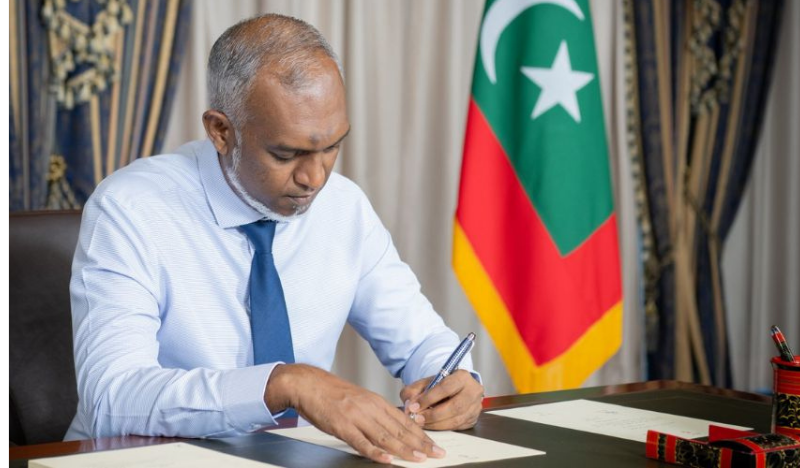
Both amendments came into effect today after they were published in the gazette. | Photo: President’s Office
President Muizzu has ratified the First Amendment to the Utility Regulatory Authority (URA) Act, and the second amendment to the Waste Management Act today, introducing legislative changes to strengthen the administrative governance of the URA, and overhauling the Maldives’ environmental framework by establishing a dedicated Environmental Regulatory Authority (ERA).
The second amendment to the URA Act, passed by the parliament on August 17, introduces legislative changes to strengthen the administrative governance of the URA.
The amendments, approved by Parliament on 19 August 2026, came into force today, after it was published in the government gazette. Under the amendments, the ERA will operate within the Environment Ministry, assuming regulatory and enforcement responsibilities from the URA.
Amendments to the Utility Regulatory Authority Act
Key changes include increasing the number of Board members and revising the procedures governing their appointment, eligibility and terms of office.
Under the amendment, the Board of Directors will increase from five to seven members, including the Chief Executive appointed by the President. The amendment also requires the appointment of a legal professional to the Board and establishes formal procedures for conducting Board meetings.
Amendments to the Waste Management Act
The revised legislation expands technical standards under Section 8, granting the new Authority direct power to regulate the design, establishment, and operation of waste facilities, disposal systems, and equipment. Under revised Article 24 and new Article 24 (a), facility operators and industrial waste producers must create operational plans aligned with national and regional master plans. The previous law did not distinguish between general site plans and specific industrial waste plans. Article 63 maintains fines of up to MVR 50,000 for failing to produce these required industrial plans, while Article 64 clarifies that any fines collected from island or city councils must be deposited in line with the State Finance Act.
Additionally, the amendment introduces waste-specific licensing categories under Article 25 and adds precise legal definitions to Article 76 for key terms, including “Industrial Waste,” “Corrosive Substances,” and “Bioaccumulative Substances”. These reforms build on prior parliamentary measures that banned waste imports to protect the domestic environment and addressed public opposition to plastic bag fees by removing the MVR 2 charge on bulk bag bundles while retaining it for single-use point-of-sale bags.
Both amendments came into effect today after they were published in the gazette, and laws require the new authority to publish updated, compliant regulations within 30 days.