

Bangladesh High Commission Donates Ambassador’s Book to MNU to Boost Academic Cooperation
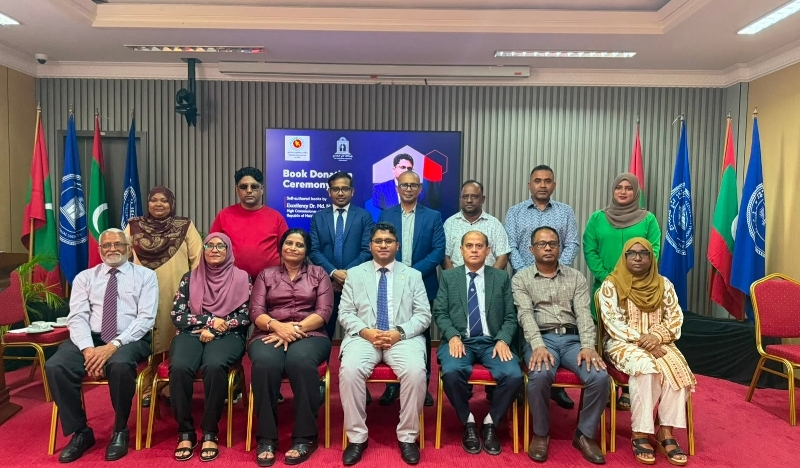
The book, authored by Bangladesh High Commissioner to the Maldives, Dr Md Nazmul Islam, were formally received by MNU Vice Chancellor Dr Aishath Shehenaz. | Photo: Bangladesh High Commission in the Maldives
The Bangladesh High Commission has donated copies of Power of Bonding and Non-Western Soft Power Strategy, authored by the Bangladesh High Commissioner to the Maldives, Dr Md Nazmul Islam, to the Maldives National University (MNU) in a move aimed at strengthening academic cooperation and knowledge exchange between the two countries.
The copies were formally received by MNU Vice Chancellor Dr Aishath Shehenaz Adam during a ceremony held at the university.
advertisement

The event was attended by Pro-Vice Chancellor, the Chief Librarian, senior university officials, faculty members, researchers, representatives of the Bangladesh High Commission, members of the Bangladeshi community in the Maldives and other invited guests.
Speaking at the ceremony, High Commissioner Dr Nazmul Islam said university libraries serve not only as repositories of books but also as centres of learning, innovation, research and intellectual development.
The High Commissioner described the book’s central concept, “Power of Bonding”, as a form of soft power based on trust, friendship, mutual respect, shared values and lasting human connections.
He said that while diplomacy often focuses on political, economic and strategic interests, enduring partnerships are ultimately built on strong relationships between people, institutions and societies.
Drawing parallels with Bangladesh-Maldives relations, Dr Nazmul Islam said the long-standing friendship between the two countries reflected the concept of the “Power of Bonding”, citing cooperation built on mutual trust, solidarity and close people-to-people ties.
The High Commissioner said there was significant potential to expand collaboration between universities and research institutions in Bangladesh and the Maldives through joint research projects, academic conferences, faculty and student exchange programmes, scholarships and institutional partnerships.
He identified climate change, the blue economy, marine sciences, public health, technology, innovation, sustainable development and human resource development as areas with strong potential for future collaboration.
In her remarks, Vice Chancellor Dr Shehenaz Adam welcomed the donation and described the book as a valuable addition to the university’s library.
She said the publication would benefit students, researchers and academics interested in diplomacy, international relations and soft power studies.
The Vice Chancellor also reaffirmed MNU’s interest in expanding cooperation with universities and research institutions in Bangladesh, expressing confidence that greater academic engagement would further strengthen bilateral ties between the two countries.