

Dr Shamheed Calls for Abolition of Permanent Address System as Parliament Rejects Reform Bill
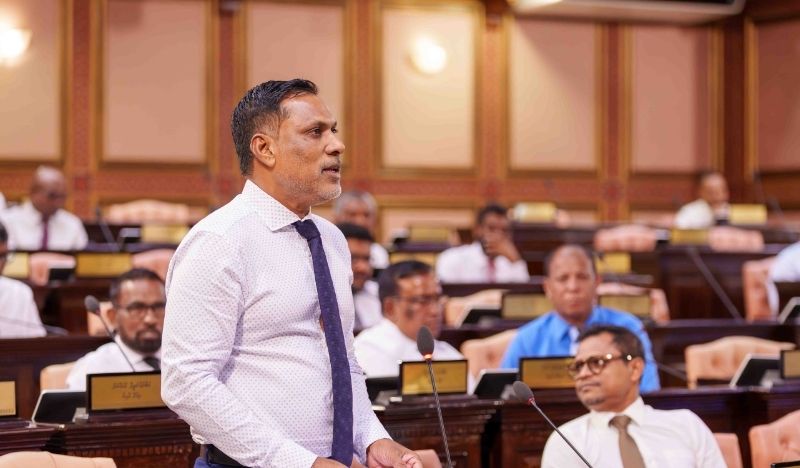
South Hulhumalé MP Dr Ahmed Shamheed. | Photo: People’s Majlis
South Hulhumalé MP Dr Ahmed Shamheed has called for the complete abolition of the Maldives’ permanent address system, arguing that it institutionalises discrimination and denies equal rights to citizens, as Parliament rejected a bill seeking to reform the law.
The proposed amendment to the Citizenship Act, submitted by Galolhu North MP Mohamed Ibrahim (Kudu), of the opposition Maldivian Democratic Party (MDP), was voted down by the government-dominated Parliament, with 59 MPs voting against the bill and 12 in favour.
advertisement

Speaking during the debate, Dr Shamheed described the current legal framework governing island residency as outdated and inconsistent with the principle of equality. He said all Maldivian citizens should enjoy the same rights regardless of where they are registered.
Drawing on his personal experience, Dr Shamheed said he moved to Malé in 1992 and had to pay rent and school fees, leaving him feeling like a second-class citizen. He also recalled that access to higher education at the time was influenced by a person’s registered address, family lineage and social status.
Dr Shamheed said the Constitution guarantees equal rights for all citizens and prohibits discrimination based on place of residence or migration. He argued that the Citizenship Act undermines these constitutional principles by maintaining the permanent address system.
“A person from Malé, whom I studied with, had children who were born and raised in the United Kingdom. Yet, they remain ‘Malé residents’ and receive the standard 1,250-square-foot plot in the Malé area,” Dr Shamheed told Parliament.
“Meanwhile, there are families who were born here, whose parents and children were born here, and who have been on the special registry (Dhaftharu) for 40 years. Yet, they are not considered Malé residents and have been stripped of their rights.”
He said the Citizenship Act was directly responsible for depriving citizens of fundamental rights and argued that the law should be abolished.
Dr Shamheed also criticised what he described as the concentration of public spending in the Greater Malé region. He said the capital had been developed using funds contributed by taxpayers across the country and claimed that around 90 per cent of the state’s US$4 billion debt had been spent on projects in the Greater Malé area and the real estate sector. He argued that spending beyond the economy’s capacity had contributed to financial pressures, including the rise of the black market exchange rate for the US dollar to MVR21.
The proposed amendment sought to reform the existing requirement for citizens to reside continuously in an island for five years before changing their registered address. Under the bill, citizens would have been allowed to register their permanent address in an island where they own land, a house or a flat.
According to the bill, the changes were intended to remove barriers faced by citizens and modernise the legal framework to better reflect the country’s current social and economic realities.
However, the bill has faced strong opposition from pro-government MPs, who dismissed the amendment as unnecessary. Government lawmakers argued that adequate provisions already exist for individuals wishing to change their residency when necessary.
Some majority-party MPs went further, alleging that the amendment is a politically motivated strategy. They claimed that since opposition parties hold majorities in certain island councils, the law is being altered as part of a calculated plan to facilitate the distribution of local tourism land to specific, preferred parties.