

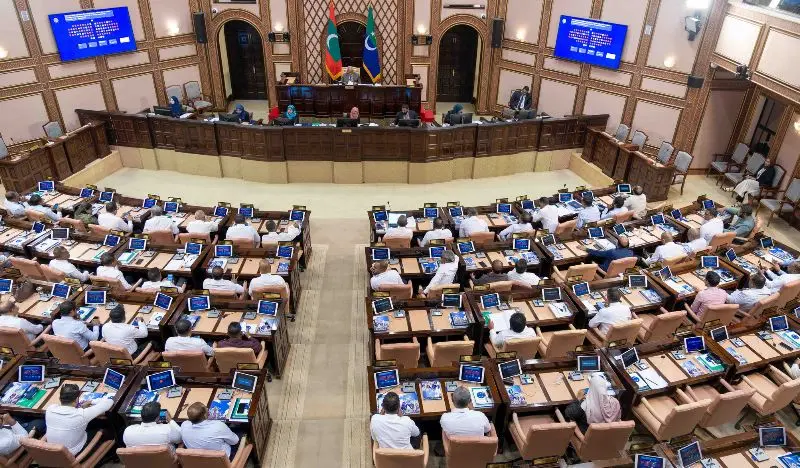
The Government has submitted a comprehensive amendment bill to the Judicature Act to the People’s Majlis, proposing to guarantee the judiciary’s financial independence by allocating at least 2% of estimated annual state revenue to the sector and expanding the High Court bench from its current 11 judges to 15 judges.
Sponsored by Feydhoo North MP Ismail Nizar on behalf of the Government, the legislation aims to overhaul the administrative, financial, and structural framework of the Maldivian court system while resolving key challenges in law enforcement.


Under the proposed Section 106, funds required for the courts and judicial administration must be included in the annual State Budget and disbursed from the State Treasury at a minimum threshold of 2% of the estimated state revenue approved by Parliament. These funds will be managed by a newly established Department of Judicial Administration (DJA) and distributed to individual courts based on a fiscal formula determined in consultation with the Chief Justice.
In a major structural expansion, the amendment to Section 27 increases the composition of the High Court to a total of 15 judges, comprising the Chief Judge and 14 additional judges. For Superior Courts, the bill proposes determining the number of judges proportionally based on the volume of submitted and ongoing cases, while mandating that every island with a Magistrate Court must have a resident Magistrate stationed there.
The bill also formalizes the establishment of two key administrative bodies within the judicial power.
Operating as a separate office led by a Chief Judicial Administrator, the Department of Judicial Administration (DJA) will oversee court budgets, infrastructure, staff recruitment, registrar appointments, and the public publication of court statistics and rulings.
Meanwhile, a newly established Judicial Council, chaired by the Chief Justice and comprising representatives from the Supreme Court, High Court, Superior Courts, and rotating Chief Magistrates from across the atolls will formulate key judicial policies, advise on court administration, and hold primary responsibility for drafting court regulations and standards.
Additional provisions in the bill require all Supreme Court trial hearings and verdicts to be conducted in sessions open to the public unless expressly exempted by law, set a standard 30-day window for appealing High Court rulings to the Supreme Court (outside of civil, criminal, and specialized statutory timelines), and establish formal legal definitions and penalties for contempt of court.