

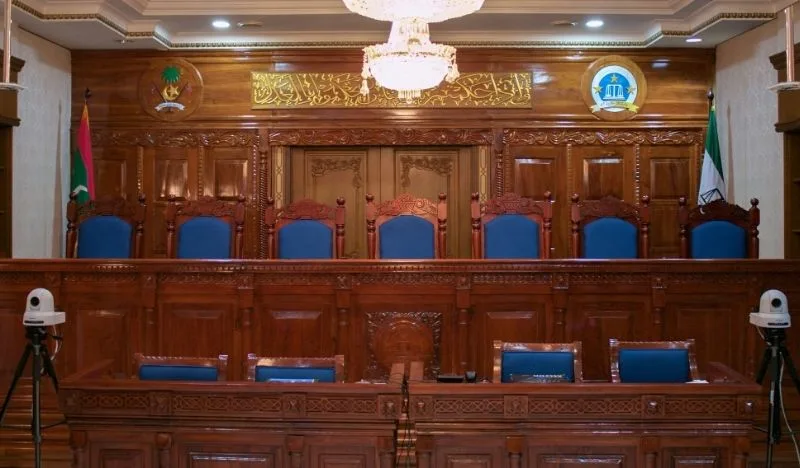
The Government’s newly proposed amendment bill to the Judicature Act introduces strict penalties for contempt of court committed outside the courtroom, alongside sweeping financial and structural reforms for the Maldivian judiciary.
Sponsored by North Feydhoo MP Ismail Nizar on behalf of the Government and introduced in Parliament on Wednesday, the legislation adds a dedicated chapter to the Judicature Act, formally defining contempt of court, establishing clear statutory exemptions, and prescribing severe punishments, particularly for offences committed outside court premises.


Penalties and Timelines
Under the proposed provisions, any individual found in contempt of court outside the courtroom faces a fine of up to MVR 100,000 and imprisonment for up to three months. By comparison, contempt committed inside a courtroom carries a fine not exceeding MVR 25,000 and imprisonment for between seven and 14 days.
While penalties for contempt committed during a court hearing must be issued within 24 hours, courts are granted a six-month window to determine penalties for out-of-court offences.
The legislative push follows controversial contempt rulings in May 2026 under existing regulations, in which two journalists were jailed for acts outside the courtroom: Leevan Ali Nasir for 10 days over a news report on a Criminal Court gag order, and Mohamed Shahuzan for 15 days over asking President Dr Mohamed Muizzu a question during a press conference.
Defining Contempt of Court
Inside a Court Hearing: Contempt during proceedings includes leaving a hearing without permission while it is ongoing; bringing in or using unauthorised audio, video, or photographic recording devices; recording or photographing proceedings without permission; refusing without valid excuse to attend, testify, take an oath, sign a prior statement, or submit required documents; attempting or intending to harm anyone present; directing disrespectful conduct or obscene language at a judge or court staff; or assaulting, touching without consent, or damaging the property of judges, staff, attendees, or the court.
Within Court Premises: Contempt on court grounds includes publishing or distributing unauthorised recordings or photographs of a hearing, as well as directing disrespectful conduct or obscene language at judges or court employees, or committing physical assault or property damage against judges, staff, attendees, or court property.
Outside a Court Hearing: Out-of-court contempt covers knowingly and willfully disobeying a court judgment, order, or directive, as well as intimidating or intentionally obstructing parties, witnesses, experts, lawyers, judges, or court staff from accessing the court or performing their duties.
It further penalises anyone who, through spoken words, writing, gestures, visible actions, or any other means in a public place or in a manner visible or audible to the public, creates or attempts to create a false, negative impression of the court; influences or obstructs an ongoing trial by publishing false material implying a pending issue has already been decided; directly or indirectly hinders the lawful conduct of a hearing; or otherwise obstructs the administration of justice.
Statutory Exemptions and Press Protections
To balance judicial authority with constitutional rights, the proposed Section 83 outlines specific acts that do not constitute contempt of court under Section 82.
Within the bounds of constitutional freedom of expression and press freedom, fair and accurate reporting made in good faith during a trial or within a reasonable period after its conclusion is protected, covering reports on open hearings, academic criticism of judgments, and summaries of closed-door hearings or orders unless barred by law or court non-publication orders regarding juvenile justice or commercial trade secrets.
The bill also exempts statements made under constitutional or legal privilege; good-faith complaints of judicial misconduct or corruption submitted to relevant authorities with reasonable evidence; good-faith arguments made in recusal requests or appeals; and actions taken in good faith by legal counsel within their professional code of conduct.
Additional protections cover innocent third-party distributors unaware of contemptuous content, publications made without knowledge or reasonable grounds to suspect a trial is ongoing, foreign publications not reasonably expected to reach the Maldivian public, unknowing recording or sharing of online hearings, and good-faith inability to comply with a court order or undertaking due to reasonable cause.
Financial Independence, High Court Expansion, and Administrative Reforms
Alongside the contempt provisions, the bill seeks to guarantee the judiciary’s financial independence under the proposed Section 106, requiring that funds for the courts and judicial administration be included in the annual State Budget and disbursed from the State Treasury at a minimum threshold of 2% of estimated state revenue approved by Parliament. These funds will be managed by a newly established Department of Judicial Administration (DJA) and distributed to individual courts based on a fiscal formula determined in consultation with the Chief Justice.
In a structural expansion under Section 27, the High Court bench will increase from its current 11 judges to 15 judges, comprising the Chief Judge and 14 additional judges. For Superior Courts, the bill proposes determining the number of judges proportionally based on the volume of submitted and ongoing cases, while mandating that every island with a Magistrate Court must have a resident Magistrate stationed there.
The bill also formalizes two key administrative bodies within the judiciary. Operating as a separate office led by a Chief Judicial Administrator, the Department of Judicial Administration (DJA) will oversee court budgets, infrastructure, staff recruitment, registrar appointments, and the public publication of court statistics and rulings. Meanwhile, a newly established Judicial Council, chaired by the Chief Justice and comprising representatives from the Supreme Court, High Court, Superior Courts, and rotating Chief Magistrates from across the atolls, will formulate judicial policies, advise on court administration, and hold primary responsibility for drafting court regulations and standards.
Additional provisions mandate that all Supreme Court trial hearings and verdicts be conducted in sessions open to the public unless expressly exempted by law, and set a standard 30-day window for appealing High Court rulings to the Supreme Court outside of civil, criminal, and specialized statutory timelines.