
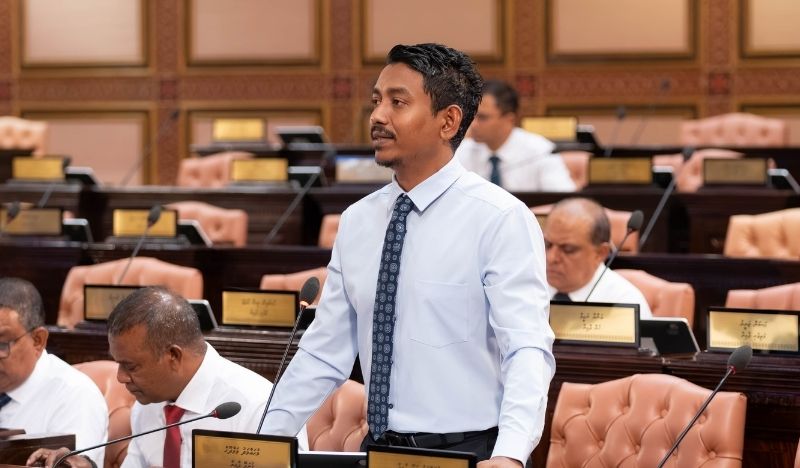
Maldives is concluding its second consecutive year without submitting a supplementary budget, marking a decisive end to past practices of mid-year spending expansions, People’s National Congress (PNC) lawmaker Mohamed Mamdhooh declared during parliamentary debate on the proposed state budget.
Speaking on the Majlis floor, the Fonadhoo MP credited the administration of President Dr Mohamed Muizzu with restoring fiscal discipline and steering public finances away from habitual mid-term deficit spending.
advertisement

advertisement

“In the past, the practice was to pass a supplementary budget once the year reached its midpoint,” Mamdhooh said. “However, as a result of this administration and President Dr Mohamed Muizzu steering the Maldivian economy in the right direction and establishing discipline and robustness in public financial management, this year marks the second consecutive year we are concluding without submitting a supplementary budget, putting an end to that harmful habit in the Maldives.”
The practice of seeking mid-year fiscal injections had been a recurring feature of prior legislative sessions. In late 2023, parliament approved an MVR 6.5 billion supplementary budget, expanding total spending to MVR 49.3 billion. In October 2024, the Majlis passed an additional MVR 5.1 billion top-up, raising the 2024 state budget from an initial MVR 49.8 billion to MVR 55 billion.
The claim of fiscal discipline drew sharp criticism from the opposition, who accused the administration of presenting unrealistic economic forecasts.
Opposition Maldivian Democratic Party (MDP) MP for Galolhu Uthuru, Meekail Ahmed Naseem, strongly contested the government’s economic projections, arguing that ordinary citizens face worsening living conditions.
“Looking at this budget, I dare say that by the time the Finance Minister arrives next year to present the projected state budget for 2028, the situation of ordinary Maldivian citizens will be worse than it is now,” Meekail said.
“Under normal circumstances, when debating a budget, the assumption is that the budget has been submitted on the basis of truth, on the basis of sound arithmetic. We set out to debate taking that as a given premise. However, what we see in this budget is the deceitful budget of a deceitful leader. It is a budget submitted to sell lies to the public through manipulated figures and falsified numbers.”
The debate follows the formal presentation of the proposed state budget of MVR 59.7 billion for the fiscal year 2027 by Minister of Finance and Public Enterprises Hassan Zareer on October 29. The proposal reflects an expenditure reduction of MVR 4.5 billion compared to the budget approved for 2026.
Minister Zareer described the blueprint as a consolidation plan centered on macroeconomic stabilization, disciplined spending, and streamlined revenue mobilization without imposing new tax burdens on households or private businesses.
According to the ministry’s macroeconomic outlook, national economic growth is expected to moderate to between 0.8 percent and 1.6 percent in 2026, revised downward from an initial 5.3 percent forecast due to external pressures after expanding by 6.3 percent in 2025.
Gross domestic product (GDP) growth is projected to rebound to between 3.9 percent and 6.8 percent in 2027, with domestic inflation projected at approximately 1.0 percent.
Gross official foreign reserves are projected to stand at USD 817 million by the end of 2026 before climbing to USD 907.2 million by the end of 2027.
Of the total MVR 59.7 billion fiscal envelope, net state expenditure is targeted at MVR 52.6 billion. Recurrent expenditure accounts for MVR 42.7 billion to cover civil service wages, administrative costs, operational expenses, and targeted subsidies, while MVR 9.9 billion is allocated to capital expenditure.
Under the capital allocation, MVR 8.2 billion is dedicated to the Public Sector Investment Programme (PSIP) to complete ongoing infrastructure developments across the atolls. Total state revenues and grants are projected at MVR 43.2 billion, an increase of MVR 1.4 billion compared to the 2026 budget envelope.
To achieve its revenue targets without new taxes, the government plans to widen the existing tax net, eliminate administrative loopholes, and roll out a standardized electronic invoicing system across commercial sectors.